


Page 444 - Global Tectonics
P. 444
426   REVIEW QUESTIONS


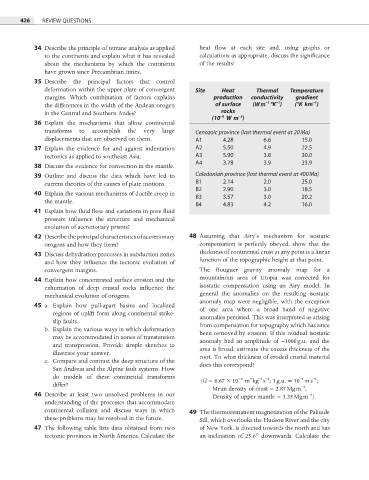
           34  Describe the principle of terrane analysis as applied   heat flow at each site and, using graphs or
              to the continents and explain what it has revealed   calculations as appropriate, discuss the signifi cance
              about the mechanisms by which the continents   of the results:
              have grown since Precambrian times.
           35  Describe the principal factors that control
              deformation within the upper plate of convergent   Site  Heat   Thermal   Temperature
              margins. Which combination of factors explains   production   conductivity   gradient
                                                                                            −1
                                                                              −1
                                                                                 −1
              the differences in the width of the Andean orogen   of surface   (W m  °K )  (°K  km )
              in the Central and Southern Andes?                 rocks
                                                                      −3
                                                                 −6
                                                               (10   W  m )
           36  Explain the mechanisms that allow continental
              transforms to accomplish the very large     Cenozoic province (last thermal event at 20 Ma)
              displacements that are observed on them.    A1      4.28        6.6        15.0
           37  Explain the evidence for and against indentation   A2  5.50    4.9        22.5
              tectonics as applied to southeast Asia.     A3      5.90        3.8        30.0
                                                          A4      3.78        3.9        23.9
           38  Discuss the evidence for convection in the mantle.
           39  Outline and discuss the data which have led to   Caledonian province (last thermal event at 400 Ma)
              current theories of the causes of plate motions.  B1  2.14      2.0        25.0
                                                          B2      2.90        3.0        18.5
           40  Explain the various mechanisms of ductile creep in
                                                          B3      3.57        3.0        20.2
              the mantle.
                                                          B4      4.83        4.2        16.0
           41  Explain how fl uid fl ow and variations in pore fl uid

              pressure influence the structure and mechanical
              evolution of accretionary prisms?
           42  Describe the principal characteristics of accretionary   48  Assuming that Airy’s mechanism for isostatic
              orogens and how they form?                   compensation is perfectly obeyed, show that the
                                                           thickness of continental crust at any point is a linear
           43  Discuss dehydration processes in subduction zones

              and how they influence the tectonic evolution of   function of the topographic height at that point.
              convergent margins.                          The Bouguer gravity anomaly map for a
           44  Explain how concentrated surface erosion and the   mountainous area of Utopia was corrected for
                                                           isostatic compensation using an Airy model. In
              exhumation of deep crustal rocks infl uence  the
              mechanical evolution of orogens.             general the anomalies on the resulting isostatic
                                                           anomaly map were negligible, with the exception
           45  a.   Explain how pull-apart basins and localized
                                                           of one area where a broad band of negative
                regions of uplift form along continental strike-
                                                           anomalies persisted. This was interpreted as arising
                slip faults.
                                                           from compensation for topography which has since
              b.   Explain the various ways in which deformation
                                                           been removed by erosion. If this residual isostatic
                may be accommodated in zones of transtension
                                                           anomaly had an amplitude of  −1000 g.u.  and  the
                and transpression. Provide simple sketches to
                                                           area is broad, estimate the excess thickness of the
                illustrate your answer.
                                                           root. To what thickness of eroded crustal material
              c.   Compare and contrast the deep structure of the
                                                           does this correspond?
                San Andreas and the Alpine fault systems. How
                do models of these continental transforms             −11  3  −1 −2     −6  −2
                                                           (G = 6.67 × 10  m  kg  s ; 1 g.u. = 10  m s ;
                differ?                                                                 −3
                                                               Mean density of crust = 2.85 Mg m ;
           46  Describe at least two unsolved problems in our      Density of upper mantle = 3.35 Mg m ).
                                                                                           −3
              understanding of the processes that accommodate
              continental collision and discuss ways in which   49  The thermoremanent magnetization of the Palisade
              these problems may be resolved in the future.  Sill, which overlooks the Hudson River and the city
           47  The following table lists data obtained from two   of New York, is directed towards the north and has
              tectonic provinces in North America. Calculate the   an inclination of 25.6° downwards. Calculate the

