


Page 357 - HVAC Pump Handbook
P. 357
Rishel_CH13.qxd  20/4/06  6:40 PM  Page 354


                                     Pumping Open Thermal Storage Tanks

                    354   Pumps for Open HVAC Cooling Systems

                      A number of studies of the energy consumed by chillers have been
                    conducted by various companies to determine the value of energy
                    storage in reducing on-peak demand charges and overall efficient
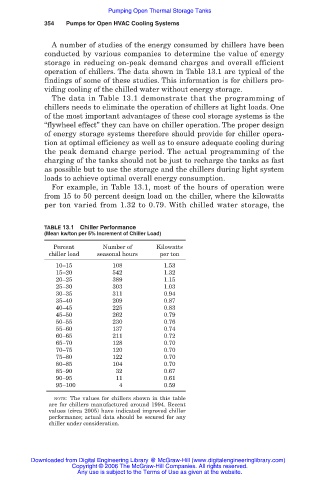
                    operation of chillers. The data shown in Table 13.1 are typical of the
                    findings of some of these studies. This information is for chillers pro-
                    viding cooling of the chilled water without energy storage.
                      The data in Table 13.1 demonstrate that the programming of
                    chillers needs to eliminate the operation of chillers at light loads. One
                    of the most important advantages of these cool storage systems is the
                    “flywheel effect” they can have on chiller operation. The proper design
                    of energy storage systems therefore should provide for chiller opera-
                    tion at optimal efficiency as well as to ensure adequate cooling during
                    the peak demand charge period. The actual programming of the
                    charging of the tanks should not be just to recharge the tanks as fast
                    as possible but to use the storage and the chillers during light system
                    loads to achieve optimal overall energy consumption.
                      For example, in Table 13.1, most of the hours of operation were
                    from 15 to 50 percent design load on the chiller, where the kilowatts
                    per ton varied from 1.32 to 0.79. With chilled water storage, the


                    TABLE 13.1 Chiller Performance
                    (Mean kw/ton per 5% Increment of Chiller Load)

                       Percent      Number of     Kilowatts
                     chiller load  seasonal hours  per ton
                       10–15           108           1.53
                       15–20           542           1.32
                       20–25           389           1.15
                       25–30           303           1.03
                       30–35           311           0.94
                       35–40           209           0.87
                       40–45           225           0.83
                       45–50           262           0.79
                       50–55           230           0.76
                       55–60           137           0.74
                       60–65           211           0.72
                       65–70           128           0.70
                       70–75           120           0.70
                       75–80           122           0.70
                       80–85           104           0.70
                       85–90            32           0.67
                       90–95            11           0.61
                       95–100           4            0.59
                       NOTE: The values for chillers shown in this table
                     are for chillers manufactured around 1994. Recent
                     values (circa 2005) have indicated improved chiller
                     performance; actual data should be secured for any
                     chiller under consideration.


                 Downloaded from Digital Engineering Library @ McGraw-Hill (www.digitalengineeringlibrary.com)
                            Copyright © 2006 The McGraw-Hill Companies. All rights reserved.
                             Any use is subject to the Terms of Use as given at the website.

