


Page 279 - Handbook Of Integral Equations
P. 279
b

                                         n
                                   n
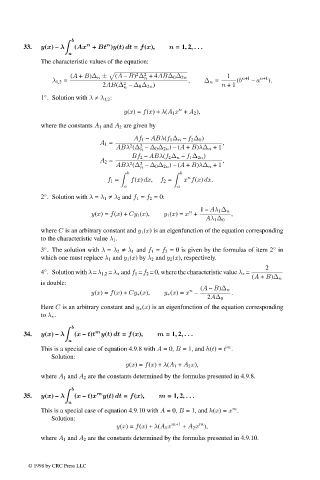
               33.   y(x) – λ  (Ax + Bt )y(t) dt = f(x),    n =1, 2, ...
                             a
                     The characteristic values of the equation:

                                                  2  2
                              (A + B)∆ n ±  (A – B) ∆ +4AB∆ 0 ∆ 2n           1    n+1  n+1
                                                    n
                        λ 1,2 =                                  ,    ∆ n =     (b   – a  ).
                                              2
                                       2AB(∆ – ∆ 0 ∆ 2n )                   n +1
                                              n
                     1 . Solution with λ ≠ λ 1,2 :
                      ◦
                                                               n
                                              y(x)= f(x)+ λ(A 1 x + A 2 ),
                     where the constants A 1 and A 2 are given by
                                                 Af 1 – ABλ(f 1 ∆ n – f 2 ∆ 0 )
                                       A 1 =                                ,
                                                2
                                                   2
                                           ABλ (∆ – ∆ 0 ∆ 2n ) – (A + B)λ∆ n +1
                                                   n
                                                Bf 2 – ABλ(f 2 ∆ n – f 1 ∆ 2n )
                                       A 2 =                                ,
                                                2
                                                   2
                                           ABλ (∆ – ∆ 0 ∆ 2n ) – (A + B)λ∆ n +1
                                                   n
                                                b               b
                                                                 n
                                         f 1 =  f(x) dx,  f 2 =  x f(x) dx.
                                              a               a
                      ◦
                     2 . Solution with λ = λ 1 ≠ λ 2 and f 1 = f 2 =0:
                                                                  n
                                    y(x)= f(x)+ Cy 1 (x),  y 1 (x)= x +  1 – Aλ 1 ∆ n  ,
                                                                       Aλ 1 ∆ 0
                     where C is an arbitrary constant and y 1 (x) is an eigenfunction of the equation corresponding
                     to the characteristic value λ 1 .
                      ◦
                                                                                           ◦
                     3 . The solution with λ = λ 2 ≠ λ 1 and f 1 = f 2 = 0 is given by the formulas of item 2 in
                     which one must replace λ 1 and y 1 (x)by λ 2 and y 2 (x), respectively.
                                                                                         2
                     4 . Solution with λ=λ 1,2 =λ ∗ and f 1 =f 2 =0, where the characteristic value λ ∗ =
                      ◦
                                                                                     (A + B)∆ n
                     is double:
                                                                  n
                                    y(x)= f(x)+ Cy ∗ (x),  y ∗ (x)= x –  (A – B)∆ n  .
                                                                       2A∆ 0
                     Here C is an arbitrary constant and y ∗ (x) is an eigenfunction of the equation corresponding
                     to λ ∗ .
                              b

                                     m
               34.   y(x) – λ  (x – t)t y(t) dt = f(x),  m =1, 2, ...
                             a
                                                                             m
                     This is a special case of equation 4.9.8 with A =0, B = 1, and h(t)= t .
                        Solution:
                                              y(x)= f(x)+ λ(A 1 + A 2 x),
                     where A 1 and A 2 are the constants determined by the formulas presented in 4.9.8.

                              b
                                      m
               35.   y(x) – λ  (x – t)x y(t) dt = f(x),  m =1, 2, ...
                             a
                                                                               m
                     This is a special case of equation 4.9.10 with A =0, B = 1, and h(x)= x .
                        Solution:
                                                                     m
                                            y(x)= f(x)+ λ(A 1 x m+1  + A 2 x ),
                     where A 1 and A 2 are the constants determined by the formulas presented in 4.9.10.


                 © 1998 by CRC Press LLC


               © 1998 by CRC Press LLC
                                                                                                             Page 258

