


Page 280 - Handbook Of Integral Equations
P. 280
b

                                           m
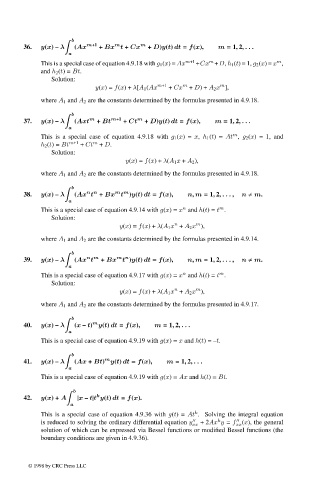
               36.   y(x) – λ  (Ax m+1  + Bx t + Cx m  + D)y(t) dt = f(x),  m =1, 2, ...
                             a
                                                                        m
                                                                                            m
                     This is a special case of equation 4.9.18 with g 1 (x)= Ax m+1  +Cx +D, h 1 (t)=1, g 2 (x)= x ,
                     and h 2 (t)= Bt.
                        Solution:
                                                                m
                                                                           m
                                     y(x)= f(x)+ λ[A 1 (Ax m+1  + Cx + D)+ A 2 x ],
                     where A 1 and A 2 are the constants determined by the formulas presented in 4.9.18.
                                b
               37.   y(x) – λ  (Axt m  + Bt m+1  + Ct m  + D)y(t) dt = f(x),  m =1, 2, ...
                             a
                                                                               m
                     This is a special case of equation 4.9.18 with g 1 (x)= x, h 1 (t)= At , g 2 (x) = 1, and
                                    m
                     h 2 (t)= Bt m+1  + Ct + D.
                        Solution:
                                              y(x)= f(x)+ λ(A 1 x + A 2 ),
                     where A 1 and A 2 are the constants determined by the formulas presented in 4.9.18.


                              b
                                   n n
                                           m m
               38.   y(x) – λ  (Ax t + Bx t )y(t) dt = f(x),     n, m =1, 2, ... ,  n ≠ m.
                             a
                                                                           m
                                                                n
                     This is a special case of equation 4.9.14 with g(x)= x and h(t)= t .
                        Solution:
                                                             n
                                                                    m
                                             y(x)= f(x)+ λ(A 1 x + A 2 x ),
                     where A 1 and A 2 are the constants determined by the formulas presented in 4.9.14.
                                b
                                            m n
                                   n m
               39.   y(x) – λ  (Ax t   + Bx t )y(t) dt = f(x),   n, m =1, 2, ... ,  n ≠ m.
                             a
                                                                n
                                                                           m
                     This is a special case of equation 4.9.17 with g(x)= x and h(t)= t .
                        Solution:
                                                                    m
                                                             n
                                             y(x)= f(x)+ λ(A 1 x + A 2 x ),
                     where A 1 and A 2 are the constants determined by the formulas presented in 4.9.17.
                                b
                                    m
               40.   y(x) – λ  (x – t) y(t) dt = f(x),  m =1, 2, ...
                             a
                     This is a special case of equation 4.9.19 with g(x)= x and h(t)= –t.
                              b

                                        m
               41.   y(x) – λ  (Ax + Bt) y(t) dt = f(x),   m =1, 2, ...
                             a
                     This is a special case of equation 4.9.19 with g(x)= Ax and h(t)= Bt.

                              b
                                      k
               42.   y(x)+ A    |x – t|t y(t) dt = f(x).
                              a
                                                                   k
                     This is a special case of equation 4.9.36 with g(t)= At . Solving the integral equation
                                                                          k
                     is reduced to solving the ordinary differential equation y xx  +2Ax y = f (x), the general


                                                                                xx
                     solution of which can be expressed via Bessel functions or modified Bessel functions (the
                     boundary conditions are given in 4.9.36).
                 © 1998 by CRC Press LLC


               © 1998 by CRC Press LLC
                                                                                                             Page 259

