


Page 571 - Handbook Of Integral Equations
P. 571
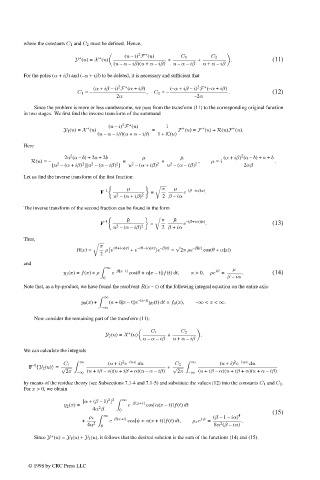
where the constants C 1 and C 2 must be defined. Hence,
                                                  2  +
                                              (u – i) F (u)    C 1      C 2
                                      +
                                +
                               Y (u)= X (u)                +        +         .            (11)
                                           (u – α – iβ)(u + α – iβ)  u – α – iβ  u + α – iβ
               For the poles (α + iβ) and (–α + iβ) to be deleted, it is necessary and sufficient that
                                            2
                                              +
                                                                      +
                                                                    2
                                     (α + iβ – i) F (α + iβ)  (–α + iβ – i) F (–α + iβ)
                                C 1 = –              ,  C 2 = –               .            (12)
                                            2α                     –2α
                   Since the problem is more or less cumbersome, we pass from the transform (11) to the corresponding original function
               in two stages. We first find the inverse transform of the summand
                                             2
                                               +
                                         (u – i) F (u)     1
                                                                               +
                                                                      +
                                                                +
                                   +
                            Y 1 (u)= X (u)            =       F (u)= F (u)+ R(u)F (u).
                                      (u – α – iβ)(u + α – iβ)  1+ K(u)
               Here
                              2
                                                                                  2
                            2u (a – b)+2a +2b      µ           ¯ µ          (α + iβ) (a – b)+ a + b
                  R(u)= –                     =          +          ,   µ = i               .
                                                2
                                                            2
                                            2
                                    2
                                 2
                          2
                        [u – (α + iβ) ][u – (α – iβ) ]  u – (α + iβ) 2  u – (α – iβ) 2  2αβ
               Let us find the inverse transform of the first fraction:
                                               µ          π  µ
                                       F –1           =         e –(β–iα)|x| .
                                            2
                                           u – (α + iβ) 2  2 β – iα
               The inverse transform of the second fraction can be found in the form
                                               ¯ µ       π   ¯ µ
                                       F –1           =         e –(β+iα)|x| .             (13)
                                            2
                                           u – (α – iβ) 2  2 β + iα
               Thus,

                                       π    iθ+iα|x|  –iθ–iα|x|    –β|x|  √  –β|x|
                               R(x)=    ρ e     + e     e   =  2πρe   cos(θ + α|x|)
                                       2
               and
                                        ∞                                      µ

                           y 1 (x)= f(x)+ ρ  e –β|x–t|  cos(θ + α|x – t|)f(t) dt,  x >0,  ρe iθ  =  .  (14)
                                        0                                    β – iα
               Note that, as a by-product, we have found the resolvent R(x – t) of the following integral equation on the entire axis:

                                        ∞
                                 y 0 (x)+  (a + b|x – t|)e –|x–t| y 0 (t) dt = f 0 (x),  –∞ < x < ∞.
                                       –∞
                   Now consider the remaining part of the transform (11):

                                               +
                                        Y 2 (u)= X (u)  C 1  +  C 2  .
                                                    u – α – iβ  u + α – iβ
               We can calculate the integrals
                                  ∞          2 –iux                 ∞          2 –iux
                  –1        C 1          (u + i) e  du       C 2           (u + i) e  du
                 F {Y 2 (u)} = √                           + √
                            2π  –∞ (u + iβ – α)(u + iβ + α)(u – α – iβ)  2π  –∞ (u + iβ – α)(u + iβ + α)(u + α – iβ)
               by means of the residue theory (see Subsections 7.1-4 and 7.1-5) and substitute the values (12) into the constants C 1 and C 2 .
               For x > 0, we obtain
                                         2 2
                                 [α +(β – 1) ]     ∞
                            y 2 (x)=           e –β(x+t)  cos[α(x – t)]f(t) dt
                                      2
                                    4α β     0
                                                                                 4         (15)
                                        ∞                                (β – 1 – iα)
                                   ρ ∗    –β(x+t)                    iψ
                                 +       e     cos[ψ + α(x + t)]f(t) dt,  ρ ∗e  =  .
                                                                           2
                                   4α 2  0                               8α (β – iα)
                        +
                   Since Y (u)= Y 1 (u)+ Y 2 (u), it follows that the desired solution is the sum of the functions (14) and (15).
                 © 1998 by CRC Press LLC
               © 1998 by CRC Press LLC
                                                                                                             Page 554

