


Page 256 - Handbook of Biomechatronics
P. 256
Lower-Limb Prosthetics                                       251


                 The vertical excursion of the center of mass is not decreased by pelvic
              obliquity or stance-phase knee flexion, which we believe provide shock
              absorption to the system (Fig. 4B) (Gard and Childress, 1997a,b, 2000;
              Childress & Gard, 1999). Most of the above theoretical results have been
              confirmed by empirical data (Miff, 2000).
                 Thus, a shock-absorbing element must be added to the above model
              (Fig. 4A) in order to stand for the natural shock absorption function pro-
              vided by the knee flexion, pelvic obliquity, ankle plantar flexion, and the
              viscoelastic properties of the tissues.
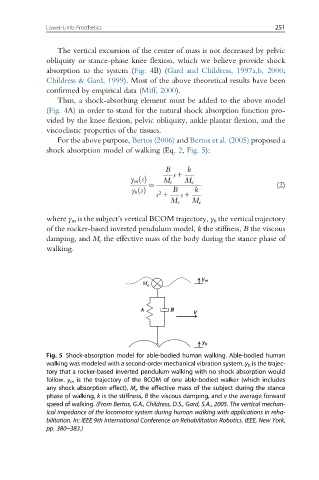
                 For the above purpose, Bertos (2006) and Bertos et al. (2005) proposed a
              shock absorption model of walking (Eq. 2, Fig. 5):

                                              B     k
                                                s +
                                    y m sðÞ  M e   M e
                                         ¼                                  (2)
                                     y b sðÞ  2  B    k
                                           s +    s +
                                               M e   M e
              where y m is the subject’s vertical BCOM trajectory, y b the vertical trajectory
              of the rocker-based inverted pendulum model, k the stiffness, B the viscous
              damping, and M e the effective mass of the body during the stance phase of
              walking.


                                                        y m
                                        M e


                                       k       B
                                                     V


                                                        y b
              Fig. 5 Shock-absorption model for able-bodied human walking. Able-bodied human
              walking was modeled with a second-order mechanical vibration system. y b is the trajec-
              tory that a rocker-based inverted pendulum walking with no shock absorption would
              follow. y m is the trajectory of the BCOM of one able-bodied walker (which includes
              any shock absorption effect), M e the effective mass of the subject during the stance
              phase of walking, k is the stiffness, B the viscous damping, and v the average forward
              speed of walking. (From Bertos, G.A., Childress, D.S., Gard, S.A., 2005. The vertical mechan-
              ical impedance of the locomotor system during human walking with applications in reha-
              bilitation. In: IEEE 9th International Conference on Rehabilitation Robotics. IEEE, New York,
              pp. 380–383.)

