


Page 463 - Handbook of Energy Engineering Calculations
P. 463
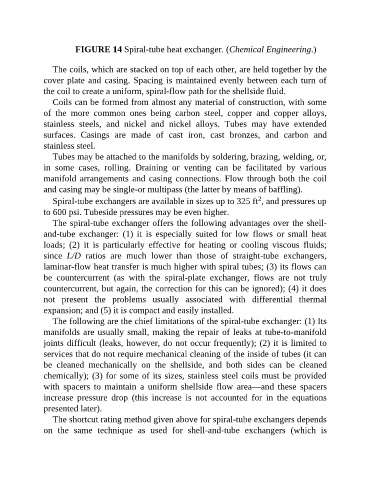
FIGURE 14 Spiral-tube heat exchanger. (Chemical Engineering.)

                  The coils, which are stacked on top of each other, are held together by the
               cover plate and casing. Spacing is maintained evenly between each turn of
               the coil to create a uniform, spiral-flow path for the shellside fluid.
                  Coils can be formed from almost any material of construction, with some

               of  the  more  common  ones  being  carbon  steel,  copper  and  copper  alloys,
               stainless  steels,  and  nickel  and  nickel  alloys.  Tubes  may  have  extended
               surfaces.  Casings  are  made  of  cast  iron,  cast  bronzes,  and  carbon  and
               stainless steel.

                  Tubes may be attached to the manifolds by soldering, brazing, welding, or,
               in  some  cases,  rolling.  Draining  or  venting  can  be  facilitated  by  various
               manifold arrangements and casing connections. Flow through both the coil
               and casing may be single-or multipass (the latter by means of baffling).
                                                                                      2
                  Spiral-tube exchangers are available in sizes up to 325 ft , and pressures up
               to 600 psi. Tubeside pressures may be even higher.
                  The spiral-tube exchanger offers the following advantages over the shell-

               and-tube  exchanger:  (1)  it  is  especially  suited  for  low  flows  or  small  heat
               loads;  (2)  it  is  particularly  effective  for  heating  or  cooling  viscous  fluids;
               since  L/D  ratios  are  much  lower  than  those  of  straight-tube  exchangers,
               laminar-flow heat transfer is much higher with spiral tubes; (3) its flows can
               be  countercurrent  (as  with  the  spiral-plate  exchanger,  flows  are  not  truly

               countercurrent, but again, the correction for this can be ignored); (4) it does
               not  present  the  problems  usually  associated  with  differential  thermal
               expansion; and (5) it is compact and easily installed.

                  The following are the chief limitations of the spiral-tube exchanger: (1) Its
               manifolds are usually small, making the repair of leaks at tube-to-manifold
               joints difficult (leaks, however, do not occur frequently); (2) it is limited to
               services that do not require mechanical cleaning of the inside of tubes (it can
               be  cleaned  mechanically  on  the  shellside,  and  both  sides  can  be  cleaned

               chemically); (3) for some of its sizes, stainless steel coils must be provided
               with  spacers  to  maintain  a  uniform  shellside  flow  area—and  these  spacers
               increase  pressure  drop  (this  increase  is  not  accounted  for  in  the  equations

               presented later).
                  The shortcut rating method given above for spiral-tube exchangers depends
               on  the  same  technique  as  used  for  shell-and-tube  exchangers  (which  is

