


Page 297 - Hardware Implementation of Finite-Field Arithmetic
P. 297
m
                                  Operations over  GF (2 )—Other Bases      277


          9.2 Triangular Bases
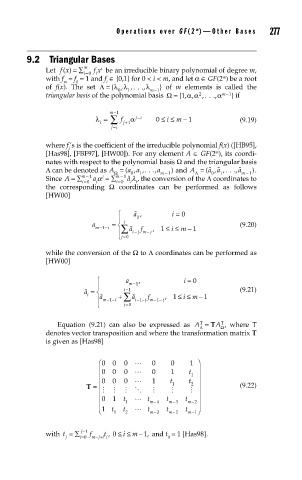
               Let  fx() =∑ m  f x  be an irreducible binary polynomial of degree m,
                              i
                         i=0  i
                                                               m
               with f  =  f  = 1 and f  ∈ {0,1} for 0 < i < m, and let α ∈ GF(2 ) be a root
                    m  0        i
                                      ,
                                    ,
               of  f(x). The set  Λ= {λλ ... ,λ  } of  m elements is called the
                                   0  1    m −1
               triangular basis of the polynomial basis  Ω= {, ,1 αα ... ,α  m  −1 } if
                                                         2
                                                          ,
                                m−1
                              i ∑
                             λ =   f  j+1 α ji  0  ≤ i ≤  m − 1     (9.19)
                                        −
                                 =
                                 ji

               where f ’s is the coefficient of the irreducible polynomial f(x) ([HB95],
                     i
                                                             m
               [Has98], [FBF97], [HW00]). For any element A ∈ GF(2 ), its coordi-
               nates with respect to the polynomial basis Ω and the triangular basis

               Λ can be denoted as A = (, ,...  a ,  m − 1 ) and A = (, , ...  a ,   m − 1 ).
                                     a a
                                                           a a
                                                        Λ
                                  Ω
                                                            0
                                         1
                                                               1
                                      0

               Since A =∑ m − 1 aα i =∑ m − 1 a λ , the conversion of the Λ coordinates to
                         i=0  i   i=0  ii
               the corresponding  Ω coordinates can be performed  as follows
               [HW00]
                                   ⎧   a   ,     i = 0
                                   ⎪
                                        0
                                    i
                            a m−−  i  = ⎨ ∑ a    ≤≤                 (9.20)
                                         f
                              1
                                   ⎪   ij m j  ,  1  i  m − 1
                                           −
                                       −
                                   ⎩ j=0
               while the conversion of the Ω to Λ coordinates can be performed as
               [HW00]
                             ⎧       a  ,            i = 0
                             ⎪        m−1
                            a = ⎨   i−1                             (9.21)
                                   +
                          i     a m−− ∑    a       ≤ i ≤
                                           f
                             ⎪  1  i   i− −1  j m−−1  j ,  1  i  m − 1
                             ⎩      j=0
                                                               T
                                                         T
                  Equation (9.21) can also be expressed as  A = T A , where T
                                                         Λ
                                                               Ω
               denotes vector transposition and where the transformation matrix T
               is given as [Has98]
                              0 ⎛  0  0     0    0    1 ⎞
                              0 ⎜  0  0     0    1    t ⎟
                             ⎜      0                  1  ⎟
                                                       2 ⎟
                          T =  ⎜ 0   ⎜  0          1    t   1  t   ⎟  (9.22)
                              0 ⎜  1  t    t    t    t  ⎟
                             ⎜       1     m − 4  m m−3  m−2 ⎟
                             ⎝ 1  t 1  t 2     t m−3  t m−2  t m− ⎠
                                                        1

               with  t =∑  j−1  f  t 0,  ≤ i ≤  m − 1,  and t  = 1 [Has98].
                             −+
                    j   i=0  mj i i             0

