


Page 427 -
P. 427
down with oop


          #7: Ooops... we could’ve covered more OOP


           Chapter 10 introduced the important concept of classes, and throughout
           the book we’ve touched on objects in lots of different places. Doing justice
           to all the concepts of object oriented programming (OOP) would easily take
           an entire book all on its own.
           The bit of OOP covered in Chapter 10 relates to the concept of
           encapsulation. This is the process of bundling data with methods into
           prebuilt templates that can be used to create functionally identical objects of a
           certain type.

           Now... if your eyes glazed over reading that last line, don’t worry; you are
           as normal as the rest of us. OOP is full of terminology like this. As well
           as encapsulation, there’s inheritance and polymorphism, too.
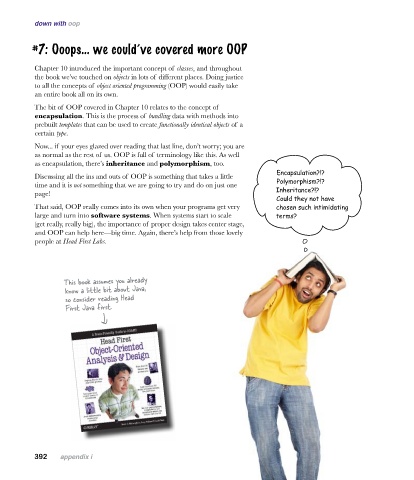
                                                                              Encapsulation?!?
           Discussing all the ins and outs of OOP is something that takes a little
           time and it is not something that we are going to try and do on just one   Polymorphism?!?
           page!                                                              Inheritance?!?
                                                                              Could they not have
           That said, OOP really comes into its own when your programs get very   chosen such intimidating
           large and turn into software systems. When systems start to scale   terms?
           (get really, really big), the importance of proper design takes center stage,
           and OOP can help here—big time. Again, there’s help from those lovely
           people at Head First Labs.


                   This book assumes you already
                   know a little bit about Java,
                   so consider reading Head
                   First Java first.


           392    appendix i

