


Page 109 - How to write effective business English your guide to excellent professional communication by Fiona Talbot
P. 109
98     How to Write Effective Business English

               Socially, it’s what we expect in this medium, poised as it is some-
             where between e-mail and conversation. But it’s best to think this
             through in your workplace. Do you want the increasingly casual
             style of instant messaging where it’s quite normal to express emo-
             tions, in words or via emoticons or even via use of punctuation, to
             cross over into your standard business e-mails too?
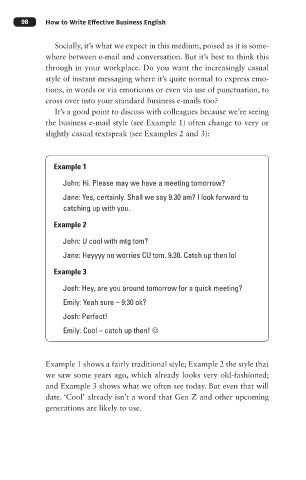
               It’s a good point to discuss with colleagues because we’re seeing
             the business e-mail style (see Example 1) often change to very or
             slightly casual textspeak (see Examples 2 and 3):


               Example 1
                 John: Hi. Please may we have a meeting tomorrow?

                 Jane: Yes, certainly. Shall we say 9.30 am? I look forward to
                 catching up with you.

               Example 2

                 John: U cool with mtg tom?
                 Jane: Heyyyy no worries CU tom. 9.30. Catch up then lol
               Example 3

                 Josh: Hey, are you around tomorrow for a quick meeting?
                 Emily: Yeah sure – 9:30 ok?

                 Josh: Perfect!
                 Emily: Cool – catch up then! J


             Example 1 shows a fairly traditional style; Example 2 the style that
             we saw some years ago, which already looks very old-fashioned;
             and Example 3 shows what we often see today. But even that will
             date. ‘Cool’ already isn’t a word that Gen Z and other upcoming
             generations are likely to use.

