


Page 387 - Intelligent Digital Oil And Gas Fields
P. 387
326                                       Intelligent Digital Oil and Gas Fields


          without needing to miniaturize continually the circuits. These new chips
          enable image processing, image recognition, self-driving cars, virtual reality
          (VR), and artificial intelligence.


          9.1.1 Nanosensors
          Nanotechnology refers to miniaturizing technology to a nanoscale so that it
          can be used in remote places where conventional sensors do not work, like
          deep in reservoirs. Naturally, O&G operations have plenty of situations
          where nanotechnologies can be used and will benefit DOF solutions.
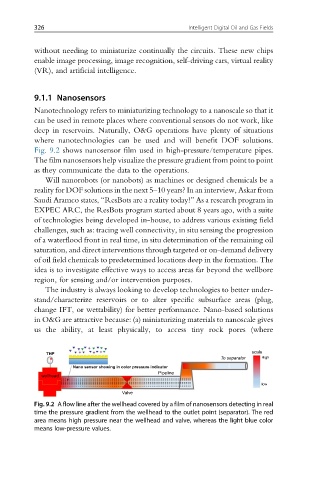
          Fig. 9.2 shows nanosensor film used in high-pressure/temperature pipes.
          The film nanosensors help visualize the pressure gradient from point to point
          as they communicate the data to the operations.
             Will nanorobots (or nanobots) as machines or designed chemicals be a
          reality for DOF solutions in the next 5–10 years? In an interview, Askar from
          Saudi Aramco states, “ResBots are a reality today!” As a research program in
          EXPEC ARC, the ResBots program started about 8 years ago, with a suite
          of technologies being developed in-house, to address various existing field
          challenges, such as: tracing well connectivity, in situ sensing the progression
          of a waterflood front in real time, in situ determination of the remaining oil
          saturation, and direct interventions through targeted or on-demand delivery
          of oil field chemicals to predetermined locations deep in the formation. The
          idea is to investigate effective ways to access areas far beyond the wellbore
          region, for sensing and/or intervention purposes.
             The industry is always looking to develop technologies to better under-
          stand/characterize reservoirs or to alter specific subsurface areas (plug,
          change IFT, or wettability) for better performance. Nano-based solutions
          in O&G are attractive because: (a) miniaturizing materials to nanoscale gives
          us the ability, at least physically, to access tiny rock pores (where


              THP                                                    scale
                                                             To separator  High
                     Nano sensor showing in color pressure indicator
                                            Pipeline
            wellhead
                                                                        low
                                  Valve
          Fig. 9.2 A flow line after the wellhead covered by a film of nanosensors detecting in real
          time the pressure gradient from the wellhead to the outlet point (separator). The red
          area means high pressure near the wellhead and valve, whereas the light blue color
          means low-pressure values.

