


Page 218 -
P. 218
I
                                                6.4  Lifecycle models: showing how the activities relate  187
                                                                                                         I
         6.4.2  Lifecycle models in software engineering
                        Software engineering has spawned many lifecycle models, including the water-
                        fall, the spiral, and rapid applications development (RAD). Before the waterfall
                        was first proposed in 1970, there was no generally agreed approach to software
                        development, but over the years since then, many models have been devised, re-
                        flecting in part the wide variety of approaches that can be taken to developing
                        software. We choose to include these specific lifecycle models for two reasons:
                        First, because they are representative of the models used in industry and they
                        have all proved to be successful, and second, because they show how the empha-
                        sis in software development has gradually changed to include a more iterative,    1
                        user-centered view.

                        The waterfall lifecycle model

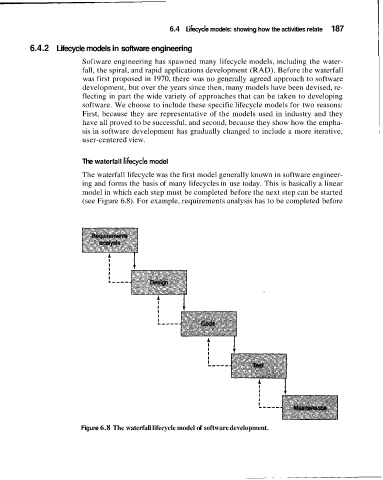
                        The waterfall lifecycle was the first model generally known in software engineer-
                        ing and forms the basis of  many lifecycles in use today. This is basically a linear
                        model in which each step must be completed before the next step can be started
                        (see Figure 6.8). For example, requirements analysis has to be completed before


                       Figure 6.8 The waterfall lifecycle model of software development.

