


Page 221 -
P. 221
190  Chapter 6   The process of interaction design

                               JAD (Joint Application Development) workshops in which users and devel-
                               opers come together to thrash out the requirements of  the system (Wood
                               and  Silver, 1995). These  are  intensive  requirements-gathering sessions in
                               which difficult issues are faced and decisions are made. Representatives from
                               each identified stakeholder group should be involved in each workshop so
                               that all the relevant views can be heard.

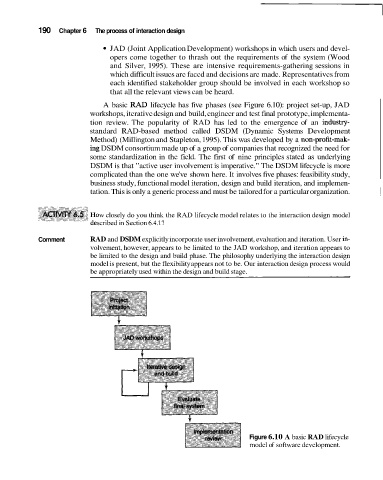
                              A basic RAD lifecycle has five phases (see Figure 6.10): project set-up, JAD
                          workshops, iterative design and build, engineer and test final prototype, implementa-
                          tion  review. The  popularity of  RAD  has  led  to  the  emergence of  an  industry-
                          standard  RAD-based  method  called  DSDM  (Dynamic  Systems  Development
                          Method) (Millington and Stapleton, 1995). This was developed by a non-profit-mak-
                          ing DSDM consortium made up of a group of companies that recognized the need for
                          some standardization in the field. The first  of  nine principles stated  as underlying
                          DSDM is that "active user involvement is imperative." The DSDM lifecycle is more
                          complicated than the one we've shown here. It involves five phases: feasibility study,
                          business study, functional model iteration, design and build iteration, and implemen-
                          tation. This is only a generic process and must be tailored for a particular organization.   ~


                            w closely do you think the RAD lifecycle model relates to the interaction design model
                            scribed in Section 6.4.1?

            Comment       RAD and DSDM explicitly incorporate user involvement, evaluation and iteration. User in-
                          volvement, however, appears to be limited to the JAD workshop, and iteration appears to
                          be limited to the design and build phase. The philosophy underlying the interaction design
                          model is present, but the flexibility appears not to be. Our interaction design process would
                          be appropriately used within the design and build stage.


                                                                      Figure 6.10 A basic RAD lifecycle
                                                                      model of software development.

