


Page 224 -
P. 224
I
                                                6.4  Lifecycle models: showing how the activities relate  193


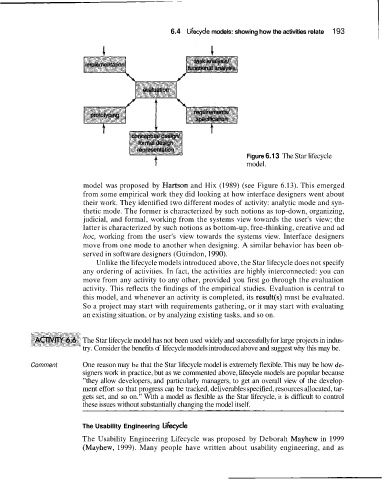
                                                                     Figure 6.13 The Star lifecycle
                                                                     model.

                        model was proposed  by Hartson and Hix (1989) (see Figure 6.13). This emerged
                        from some empirical work they did looking at how interface designers went about
                        their work. They identified two different modes of  activity: analytic mode and syn-
                        thetic mode. The former is characterized by such notions as top-down, organizing,
                        judicial, and formal, working from the systems view towards the user's  view; the
                        latter is characterized by such notions as bottom-up, free-thinking, creative and ad
                        hoc, working from the user's  view towards the systems view. Interface designers
                        move from one mode to another when designing. A similar behavior has been ob-
                        served in software designers (Guindon, 1990).
                            Unlike the lifecycle models introduced above, the Star lifecycle does not specify
                        any ordering of  activities. In fact, the activities are highly interconnected: you can
                        move from any activity to any other, provided you first go through the evaluation
                        activity. This reflects the findings of the empirical studies. Evaluation is central to
                        this model, and whenever an activity is completed, its result(s) must be evaluated.
                        So a project may start with requirements gathering, or it may start with evaluating
                        an existing situation, or by analyzing existing tasks, and so on.


                        The Star lifecycle model has not been used widely and successfully for large projects in indus-
                        try. Consider the benefits of  lifecycle models introduced above and suggest why this may be.

         Comment        One reason may be that the Star lifecycle model is extremely flexible. This may be how de-
                        signers work in practice, but as we commented above, lifecycle models are popular because
                        "they allow developers, and particularly managers, to get an overall view of  the develop-
                        ment effort so that progress can be tracked, deliverables specified, resources allocated, tar-
                        gets set, and so on." With a model as flexible as the Star lifecycle, it is difficult to control
                        these issues without substantially changing the model itself.


                        The Usability Engineering Lifecycle
                        The Usability Engineering Lifecycle was proposed  by Deborah Mayhew in 1999
                        (Mayhew, 1999).  Many  people  have written  about  usability engineering, and as

