


Page 226 -
P. 226
6.4  Lifecycle models: showing how the activities relate  195


                                                                             0 UETask

                                                                              T  Development Task
                                                                             () Decision Point
                                                                                 Documentation
                                                                             + Complex Applications
                                                                             - -t Simple Applications
                                                                                    (e.g. websites)
                                                                                                          I
                        Figure 6.14  (continued).


                        Mayhew herself says, "I did not invent the concept of a Usability Engineering Life-
                        cycle. Nor did I invent any of the Usability Engineering tasks included in the lifecy-
                        cle . . . .". However, what her lifecycle does provide is a holistic view of  usability
                        engineering  and a  detailed description  of how to perform  usability tasks, and it
                        specifies how usability tasks can  be integrated into traditional software develop-
                        ment lifecycles. It is therefore particularly helpful for those with little or no exper-
                        tise in usability to see how the tasks may be performed alongside more traditional
                        software engineering activities. For example, Mayhew has linked the stages with a
                        general development approach (rapid prototyping) and a specific method (object-
                        oriented software engineering (OOSE, Jacobson et al, 1992)) that have arisen from
                        software engineering.
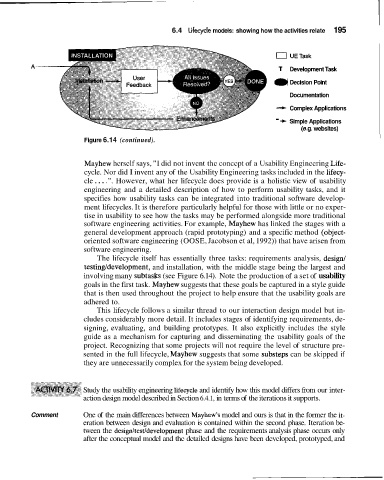
                            The lifecycle itself  has essentially three tasks: requirements analysis, design1
                        testingldevelopment, and installation, with the middle stage being the largest and
                        involving many subtasks (see Figure 6.14).  Note the production of a set of usability
                        goals in the first task. Mayhew suggests that these goals be captured in a style guide
                        that is then used throughout the project to help ensure that the usability goals are
                        adhered to.
                            This lifecycle follows a similar thread to our interaction design model but in-
                        cludes considerably more detail. It includes stages of  identifying requirements, de-
                        signing, evaluating,  and  building prototypes. It  also explicitly  includes  the style
                        guide as a  mechanism for capturing and disseminating the usability goals of the
                        project. Recognizing that some projects will not require the level of  structure pre-
                        sented in the full lifecycle, Mayhew suggests that some substeps can be skipped if
                        they are unnecessarily complex for the system being developed.


                        Study the usability engineering lifecycle and identify how this model differs from our inter-
                        action design model described in Section 6.4.1, in terms of  the iterations it supports.

          Comment       One of  the main differences between Mayhew's model and ours is that in the former the it-
                        eration between design and evaluation is contained within the second phase. Iteration be-
                        tween the design/testldevelopment phase and the requirements analysis phase occurs only
                        after the conceptual model and the detailed designs have been developed, prototyped, and

