


Page 232 - Intermediate Statistics for Dummies
P. 232
20_045206 ch13.qxd  2/1/07  10:21 AM  Page 211
                                                                 Chapter 13: Forming Associations with Two-Way Tables
                                                    Notice that Table 13-1 has four empty cells inside of it (not counting the
                                                    empty space in the upper-left corner). Because gender has two choices (male
                                                    or female), and personal cell-phone use has two choices (yes or no), the
                                                    resulting two-way table has 2  2 = 4 cells.
                                                                             *
                                                    To figure out the number of cells in any two-way table, multiply the number
                                                    of possible categories for the row variables times the number of possible
                                                    categories for the column variable.
                                                    Filling in the cell counts
                                                    After you set up the table with the appropriate number of rows and columns,
                                                    you need to fill in the appropriate numbers in each of the cells of the two-way
                                                    table. The number in each cell of a two-way table is called the cell count for
                                                    that cell. The upper-left cell in the two-way table shown in Table 13-1 repre-
                                                    sents the number of males who use their cell phones for personal calls. With
                                                    the information you have in the cell-phone problem, the cell count for this  211
                                                    cell is 325. Because you know that 427 females use their cell phones for per-
                                                    sonal calls, this number goes into the lower-left cell.
                                                    Now, to figure out the numbers in the remaining two cells, you do a bit of sub-
                                                    traction. You know from the information given that the total number of male
                                                    cell-phone users in the survey is 508. Each male either uses his cell phone for
                                                    personal calls (falling into the yes group), or he doesn’t (falling into the no
                                                    group). Because 325 males fall into the yes group, and you have 508 males
                                                    total, 183 males (508 – 325 = 183) don’t use their cell phones for personal
                                                    calls. This number is the cell count for the upper-right cell of the two-way
                                                    table. Finally, because 508 females took the survey, and 427 of them use
                                                    their cell phones for personal calls, you know that the rest of them (508 –
                                                    427 = 81) don’t. Therefore, 81 is the cell count for the lower-right cell of the
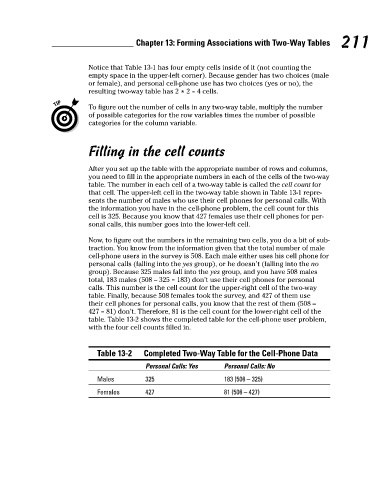
                                                    table. Table 13-2 shows the completed table for the cell-phone user problem,
                                                    with the four cell counts filled in.
                                                      Table 13-2   Completed Two-Way Table for the Cell-Phone Data
                                                                   Personal Calls: Yes   Personal Calls: No
                                                      Males        325                   183 (508 – 325)
                                                      Females      427                   81 (508 – 427)

