


Page 228 - Introduction to AI Robotics
P. 228
6.5 Proximity Sensors


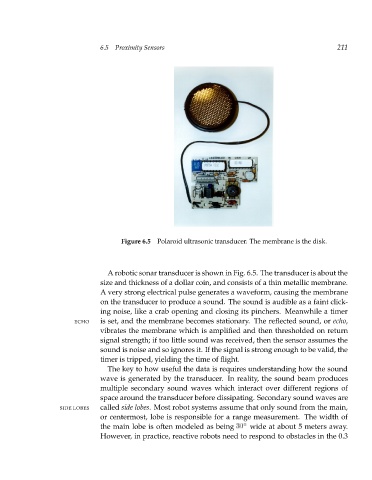
                                            Figure 6.5 Polaroid ultrasonic transducer. The membrane is the disk.  211


                                        A robotic sonar transducer is shown in Fig. 6.5. The transducer is about the
                                      size and thickness of a dollar coin, and consists of a thin metallic membrane.
                                      A very strong electrical pulse generates a waveform, causing the membrane
                                      on the transducer to produce a sound. The sound is audible as a faint click-
                                      ing noise, like a crab opening and closing its pinchers. Meanwhile a timer
                               ECHO   is set, and the membrane becomes stationary. The reflected sound, or echo,
                                      vibrates the membrane which is amplified and then thresholded on return
                                      signal strength; if too little sound was received, then the sensor assumes the
                                      sound is noise and so ignores it. If the signal is strong enough to be valid, the
                                      timer is tripped, yielding the time of flight.
                                        The key to how useful the data is requires understanding how the sound
                                      wave is generated by the transducer. In reality, the sound beam produces
                                      multiple secondary sound waves which interact over different regions of
                                      space around the transducer before dissipating. Secondary sound waves are
                           SIDE LOBES  called side lobes. Most robot systems assume that only sound from the main,
                                      or centermost, lobe is responsible for a range measurement. The width of
                                      the main lobe is often modeled as being 30     wide at about 5 meters away.
                                      However, in practice, reactive robots need to respond to obstacles in the 0.3

