


Page 449 - Introduction to AI Robotics
P. 449
432
                                     Exercise 11.7                             11  Localization and Map Making
                                     Suppose a localization algorithm had an order complexity of O(m   n),where m is
                                     the number of columns and n is the number of rows in the occupancy grid. Therefore
                                     if the algorithm operated over a 10   10 grid, approximately 100 operations would be
                                     executed for localization. What would be the number of operations if the grid were:
                                     a. 100    100  ?
                                     b. 1000    1000  ?
                                     c. 5000    2000  ?

                                     Exercise 11.8
                                                                                             2
                                     Repeat the previous problem where the order complexity is O(( m   n) ).
                                     Exercise 11.9
                                     Consider a robot beginning to map a new area (the occupancy grid is at an ini-
                                     tial unsensed state), and how three different sonar updates create a certainty value

                                     for a particular grid element. The sonar model is: range is 12, it’s   = 15 ,the
                                                                                         0
                                     M   occupancy  =  a:98 ,and the tolerance is pm 1:0.At time t1, the sonar reading re-
                                                           x
                                     turns 10.0. The grid element of interest is 9.5 units away from the robot with an
                                     of 0.0. At t2, the robot has translated sideways. The sonar reading is 11.0. The grid
                                     element is now 9.5 units away with an   =  :0.At t3, the sonar returns a value of  1            4
                                     8.5 units. The robot has moved to the side and rotated; it is now 9.0 units from the

                                     grid element with an   of 5 .
                                     a. What is the initial value of every element in the occupancy grid for
                                          i) Bayesian
                                          ii) Dempster-Shafer
                                          iii) HIMM
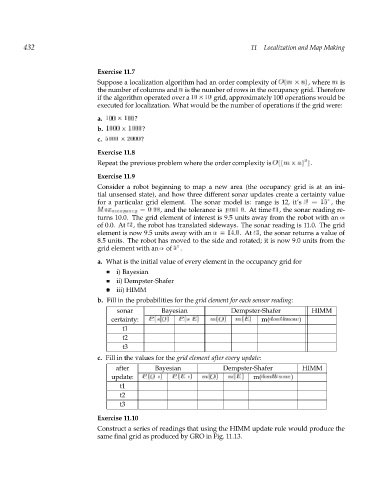
                                     b. Fill in the probabilities for the grid element for each sensor reading:
                                          sonar       Bayesian           Dempster-Shafer       HIMM
                                         certainty:  P (sjO)  P (sjE)  m(O)  m(E)  m(dontknow  )
                                            t1
                                            t2
                                            t3
                                     c. Fill in the values for the grid element after every update:
                                          after      Bayesian          Dempster-Shafer       HIMM
                                         update:  P (Ojs)  P (Ejs)  m(O)  m(E)  m(dontknow  )
                                           t1
                                           t2
                                           t3

                                     Exercise 11.10
                                     Construct a series of readings that using the HIMM update rule would produce the
                                     same final grid as produced by GRO in Fig. 11.13.

