


Page 281 - Introduction to Information Optics
P. 281
266                     5. Transformation with Optics

       is located at the origin \r\ = 0, because it decays in the 3D space approximately
            4
       as r| , so that is well localized in the 3D space. When time progresses, the
       wavelet spreads in the space from the origin as a spherical wave in an isotropic
       and homogeneous medium.
          The electromagnetic wavelet is a solution of the Maxwell equations, because
       the light cone constraint and the invariance under the conformal group are
        respected in the mathematical treatment of the wavelet. In addition, a direct
        substitution of the expression in Eq. (5.15) into the scalar wave equation has
        shown that this wavelet is a solution of the wave equation [19].


        5.5.2. ELECTROMAGNETIC WAVELET TRANSFORM

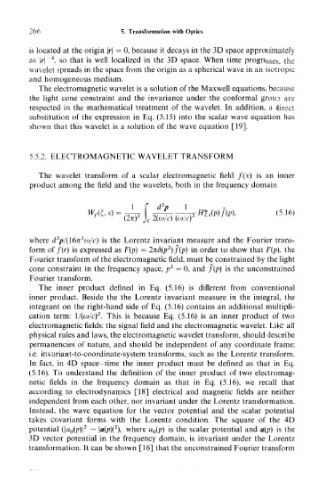
          The wavelet transform of a scalar electromagnetic field f(x) is an inner
        product among the field and the wavelets, both in the frequency domain


                                                                      (5.16)
                                        o>/c

              3
                    3
        where d p/(l6n co/c) is the Lorentz invariant measure and the Fourier trans-
                                          2
       form of f(r] is expressed as F(p) = 2nS(p ) f(p) in order to show that F(p\ the
        Fourier transform of the electromagnetic field, must be constrained by the light
                                           2
       cone constraint in the frequency space, p  = 0, and f(p) is the unconstrained
        Fourier transform.
          The inner product defined in Eq. (5.16) is different from conventional
       inner product. Beside the the Lorentz invariant measure in the integral, the
       integrant on the right-hand side of Eq. (5.16) contains an additional multipli-
                         2
       cation term: l/(co/c) . This is because Eq. (5.16) is an inner product of two
       electromagnetic fields: the signal field and the electromagnetic wavelet. Like all
       physical rules and laws, the electromagnetic wavelet transform, should describe
       permanencies of nature, and should be independent of any coordinate frame;
       i.e. invariant-to-coordinate-system transforms, such as the Lorentz transform,
       In fact, in 4D space-time the inner product must be defined as that in Eq.
       (5.16). To understand the definition of the inner product of two electromag-
       netic fields in the frequency domain as that in Eq. (5.16), we recall that
       according to electrodynamics [18] electrical and magnetic fields are neither
       independent from each other, nor invariant under the Lorentz transformation.
       Instead, the wave equation for the vector potential and the scalar potential
       takes covariant forms with the Lorentz condition. The square of the 4D
                             2
                     2
       potential (\a 0(p)\  — |«(p)| ), where a 0(p) is the scalar potential and a(p) is the
       3D vector potential in the frequency domain, is invariant under the Lorentz
       transformation. It can be shown [16] that the unconstrained Fourier transform

