


Page 675 - Introduction to Information Optics
P. 675
11.4 Information Display Using Electro-Optk Spatial Light Modulators  659


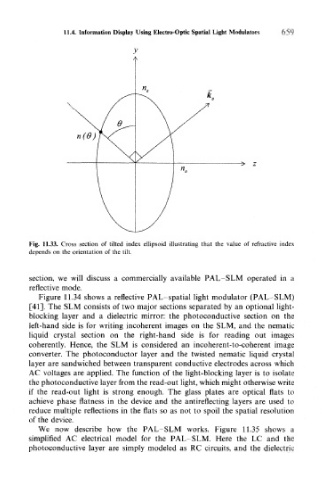
       Fig. 11.33. Cross section of tilted index ellipsoid illustrating that the value of refractive index
       depends on the orientation of the tilt.


       section, we will discuss a commercially available PAL-SLM operated in a
       reflective mode.
         Figure 11.34 shows a reflective PAL-spatial light modulator (PAL-SLM)
       [41]. The SLM consists of two major sections separated by an optional light-
       blocking layer and a dielectric mirror: the photoconductive section on the
       left-hand side is for writing incoherent images on the SLM, and the nematic
       liquid crystal section on the right-hand side is for reading out images
       coherently. Hence, the SLM is considered an incoherent-to-coherent image
       converter. The photoconductor layer and the twisted nematic liquid crystal
       layer are sandwiched between transparent conductive electrodes across which
       AC voltages are applied. The function of the light-blocking layer is to isolate
       the photoconductive layer from the read-out light, which might otherwise write
       if the read-out light is strong enough. The glass plates are optical flats to
       achieve phase flatness in the device and the antireflecting layers are used to
       reduce multiple reflections in the flats so as not to spoil the spatial resolution
       of the device.
         We now describe how the PAL-SLM works. Figure 11.35 shows a
       simplified AC electrical model for the PAL-SLM. Here the LC and the
       photoconductive layer are simply modeled as RC circuits, and the dielectric

