


Page 272 - Introduction to Mineral Exploration
P. 272
Incline
                                                                                               Vertical
                                                                              11: PROJECT EVALUATION  255
                                                                                  shaft         shaft
                                                                 Abandoned
                                                                  open pit


                                     Adit
                                     portal
                        Waste dump               Adit portal
                                                             Ore
                                                           stoped
                                                          out and
                                                         space
                                                        filled
                                                       with
                                                      waste

                        Haulage drift or level
                                                                                           Shaft pillar
                                                        Ore
                                         Sub-level       bin     Loading
                                                                 station
                      Development                                from ore
                           raise                                 bin                           Shaft
                                 Stope            Development                                  station
                                                  raise                                        with
                                 Broken ore                                                    sump
                                                                                   Raise       below
                                                    Main haulage level
                                                        Winze
                           Unbroken                               Unmined
                             ore                                    ore

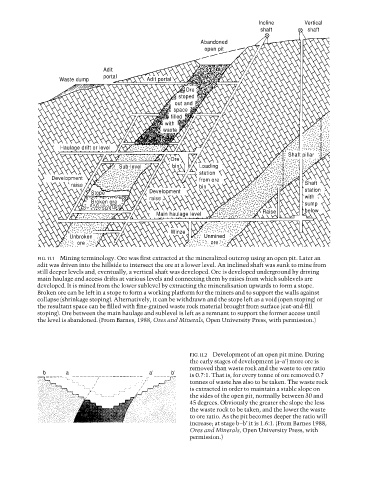
                 FIG. 11.1  Mining terminology. Ore was first extracted at the mineralized outcrop using an open pit. Later an
                 adit was driven into the hillside to intersect the ore at a lower level. An inclined shaft was sunk to mine from
                 still deeper levels and, eventually, a vertical shaft was developed. Ore is developed underground by driving
                 main haulage and access drifts at various levels and connecting them by raises from which sublevels are
                 developed. It is mined from the lower sublevel by extracting the mineralisation upwards to form a stope.
                 Broken ore can be left in a stope to form a working platform for the miners and to support the walls against
                 collapse (shrinkage stoping). Alternatively, it can be withdrawn and the stope left as a void (open stoping) or
                 the resultant space can be filled with fine-grained waste rock material brought from surface (cut-and-fill
                 stoping). Ore between the main haulage and sublevel is left as a remnant to support the former access until
                 the level is abandoned. (From Barnes, 1988, Ores and Minerals, Open University Press, with permission.)


                                                              FIG. 11.2 Development of an open pit mine. During
                                                              the early stages of development (a–a′) more ore is
                                                              removed than waste rock and the waste to ore ratio
                   b      a                       a'    b'
                                                              is 0.7:1. That is, for every tonne of ore removed 0.7
                                                              tonnes of waste has also to be taken. The waste rock
                                                              is extracted in order to maintain a stable slope on
                                                              the sides of the open pit, normally between 30 and
                                                              45 degrees. Obviously the greater the slope the less
                                                              the waste rock to be taken, and the lower the waste
                                                              to ore ratio. As the pit becomes deeper the ratio will
                                                              increase; at stage b–b′ it is 1.6:1. (From Barnes 1988,
                                                              Ores and Minerals, Open University Press, with
                                                              permission.)

