


Page 292 - Introduction to Mineral Exploration
P. 292
11: PROJECT EVALUATION  275


                                                           Traditional finance

                                                        Sponsor         Lender


                                                                                  Project finance
                                                        Project
                                                                                    Company
                                                                                     project
                                                                        Lender                   Sponsor
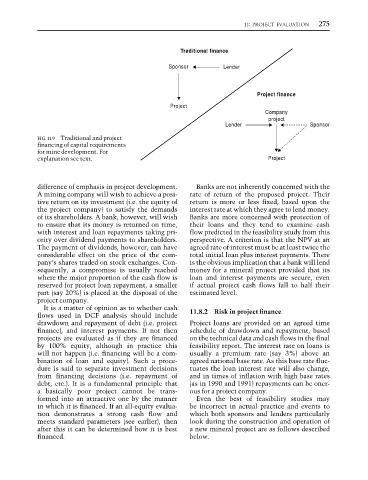
                 FIG. 11.9  Traditional and project
                 financing of capital requirements
                 for mine development. For
                 explanation see text.                                               Project


                 difference of emphasis in project development.  Banks are not inherently concerned with the
                 A mining company will wish to achieve a posi-  rate of return of the proposed project. Their
                 tive return on its investment (i.e. the equity of  return is more or less fixed, based upon the
                 the project company) to satisfy the demands  interest rate at which they agree to lend money.
                 of its shareholders. A bank, however, will wish  Banks are more concerned with protection of
                 to ensure that its money is returned on time,  their loans and they tend to examine cash
                 with interest and loan repayments taking pri-  flow predicted in the feasibility study from this
                 ority over dividend payments to shareholders.  perspective. A criterion is that the NPV at an
                 The payment of dividends, however, can have  agreed rate of interest must be at least twice the
                 considerable effect on the price of the com-  total initial loan plus interest payments. There
                 pany’s shares traded on stock exchanges. Con-  is the obvious implication that a bank will lend
                 sequently, a compromise is usually reached   money for a mineral project provided that its
                 where the major proportion of the cash flow is  loan and interest payments are secure, even
                 reserved for project loan repayment, a smaller  if actual project cash flows fall to half their
                 part (say 20%) is placed at the disposal of the  estimated level.
                 project company.
                   It is a matter of opinion as to whether cash
                 flows used in DCF analysis should include     11.8.2 Risk in project finance
                 drawdown and repayment of debt (i.e. project  Project loans are provided on an agreed time
                 finance), and interest payments. If not then  schedule of drawdown and repayment, based
                 projects are evaluated as if they are financed  on the technical data and cash flows in the final
                 by 100% equity, although in practice this    feasibility report. The interest rate on loans is
                 will not happen (i.e. financing will be a com-  usually a premium rate (say 3%) above an
                 bination of loan and equity). Such a proce-  agreed national base rate. As this base rate fluc-
                 dure is said to separate investment decisions  tuates the loan interest rate will also change,
                 from financing decisions (i.e. repayment of   and in times of inflation with high base rates
                 debt, etc.). It is a fundamental principle that  (as in 1990 and 1991) repayments can be oner-
                 a basically poor project cannot be trans-    ous for a project company.
                 formed into an attractive one by the manner    Even the best of feasibility studies may
                 in which it is financed. If an all-equity evalua-  be incorrect in actual practice and events to
                 tion demonstrates a strong cash flow and      which both sponsors and lenders particularly
                 meets standard parameters (see earlier), then  look during the construction and operation of
                 after this it can be determined how it is best  a new mineral project are as follows described
                 financed.                                     below.

