


Page 289 - Introduction to Mineral Exploration
P. 289
272   B. SCOTT & M.K.G. WHATELEY


                                          Opcost   Differential  tion. This is because, if the components which
                                                              form the cash flow are inflated at the inflation
                                           General
                                                              rate and the resultant flow is then deflated for
                   Inflation (%)          Revenue  inflation  DCF and NPV calculations at the same rate,
                                                              this will produce a flow identical with that pro-
                                                              duced by ignoring inflation altogether.
                                                                Opinions differ on the treatment of inflation
                                                              in mineral project evaluation but a safe method
                                                              is to use it as a type of sensitivity analysis
                    0    1   2    3   4    5   6              on the base case. Separate specific cost and
                                Years                         revenue items, which correlate well with pub-
                                                              lished cost indices, can be used over a limited
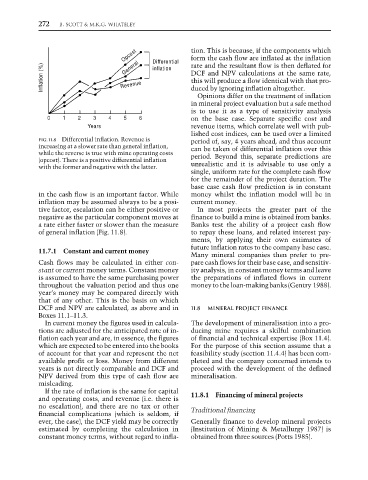
                  FIG. 11.8 Differential inflation. Revenue is  period of, say, 4 years ahead, and thus account
                  increasing at a slower rate than general inflation,  can be taken of differential inflation over this
                  while the reverse is true with mine operating costs  period. Beyond this, separate predictions are
                  (opcost). There is a positive differential inflation  unrealistic and it is advisable to use only a
                  with the former and negative with the latter.
                                                              single, uniform rate for the complete cash flow
                                                              for the remainder of the project duration. The
                                                              base case cash flow prediction is in constant
                  in the cash flow is an important factor. While  money whilst the inflation model will be in
                  inflation may be assumed always to be a posi-  current money.
                  tive factor, escalation can be either positive or  In most projects the greater part of the
                  negative as the particular component moves at  finance to build a mine is obtained from banks.
                  a rate either faster or slower than the measure  Banks test the ability of a project cash flow
                  of general inflation (Fig. 11.8).            to repay these loans, and related interest pay-
                                                              ments, by applying their own estimates of
                                                              future inflation rates to the company base case.
                  11.7.1 Constant and current money
                                                              Many mineral companies then prefer to pre-
                  Cash flows may be calculated in either  con-  pare cash flows for their base case, and sensitiv-
                  stant or current money terms. Constant money  ity analysis, in constant money terms and leave
                  is assumed to have the same purchasing power  the preparations of inflated flows in current
                  throughout the valuation period and thus one  money to the loan-making banks (Gentry 1988).
                  year’s money may be compared directly with
                  that of any other. This is the basis on which
                  DCF and NPV are calculated, as above and in  11.8  MINERAL PROJECT FINANCE
                  Boxes 11.1–11.3.
                    In current money the figures used in calcula-  The development of mineralisation into a pro-
                  tions are adjusted for the anticipated rate of in-  ducing mine requires a skilful combination
                  flation each year and are, in essence, the figures  of financial and technical expertise (Box 11.4).
                  which are expected to be entered into the books  For the purpose of this section assume that a
                  of account for that year and represent the net  feasibility study (section 11.4.4) has been com-
                  available profit or loss. Money from different  pleted and the company concerned intends to
                  years is not directly comparable and DCF and  proceed with the development of the defined
                  NPV derived from this type of cash flow are  mineralisation.
                  misleading.
                    If the rate of inflation is the same for capital
                  and operating costs, and revenue (i.e. there is  11.8.1  Financing of mineral projects
                  no escalation), and there are no tax or other
                  financial complications (which is seldom, if  Traditional financing
                  ever, the case), the DCF yield may be correctly  Generally finance to develop mineral projects
                  estimated by completing the calculation in  (Institution of Mining & Metallurgy 1987) is
                  constant money terms, without regard to infla-  obtained from three sources (Potts 1985).

