


Page 284 - Introduction to Mineral Exploration
P. 284
11: PROJECT EVALUATION  267


                 11.5.2  Operating margin to initial          than it will be at some future date because it
                         investment ratio                     can be put to work over that period. If a dollar
                                                              were invested today at an interest rate of
                 There are several variations on this theme but  15% compounded annually, it would amount
                 it produces a dimensionless number which     to $1.00 × (1 + 0.15) or $1.15 after 1 year and
                 indicates the amount of cash flow generated   $1.00 × (1.15)  = $2.01 after 5 years. This is the
                                                                         5
                 per dollar invested. It is an indication as to how  compound interest formula:
                 financially safe the investment is and the larger
                 the number the higher the value of the miner-               S = P(1 + i)n
                 alisation. It is easy to calculate and considers
                 the whole life of the project compared with  where S is the sum of money after n periods of
                 payback which considers only the first few    interest payment, i is the interest rate, and P
                 years. All factors in the cash flow (such as  the initial investment value. In this example
                 revenue, operating cost, taxes, etc.) are taken  we can say that the 5-year future value of the $1
                 into consideration and all affect the ratio  invested today at 15% is $2.01. Reversing this
                 number. However, as in payback, the time     viewpoint from the calculation of future values
                 value of money is not taken into consideration.  to one of value today, what is the value today of
                 As a simple example consider spending $100   $2.01(S) if this is a single cash flow occurring in
                 today to receive $300 in 3 years, or spending  5 years’ time at the accepted rate of interest of
                 $100 today to receive $400 in 10 years. The  15%? The answer is obviously $1.00 and the
                 increase in the ratio overfavors the latter yet  present value (P) is a variation of the compound
                 most would prefer the former. Using this     interest formula above:
                 approach the projects in Box 11.2 can be ranked
                 in order of value as C, D, B, and A.
                                                                 P =  + S  n  =  $.201  5  = .( .497  = ) $ .100
                                                                                     20
                                                                                         0
                                                                                       1
                                                                             + .15
                 11.5.3 Techniques using the time value of             (1  n)  (10  )
                         money
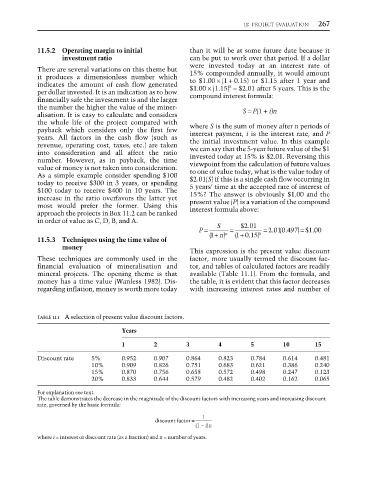
                                                              This expression is the present value discount
                 These techniques are commonly used in the    factor, more usually termed the discount fac-
                 financial evaluation of mineralisation and    tor, and tables of calculated factors are readily
                 mineral projects. The opening theme is that  available (Table 11.1). From the formula, and
                 money has a time value (Wanless 1982). Dis-  the table, it is evident that this factor decreases
                 regarding inflation, money is worth more today  with increasing interest rates and number of


                 TABLE 11.1  A selection of present value discount factors.
                                          Years

                                          1        2         3        4         5        10       15
                 Discount rate   5%       0.952    0.907     0.864    0.823     0.784    0.614    0.481
                                 10%      0.909    0.826     0.751    0.683     0.621    0.386    0.240
                                 15%      0.870    0.756     0.658    0.572     0.498    0.247    0.123
                                 20%      0.833    0.644     0.579    0.482     0.402    0.162    0.065
                 For explanation see text.
                 The table demonstrates the decrease in the magnitude of the discount factors with increasing years and increasing discount
                 rate, governed by the basic formula:
                                                                 1
                                                    discount factor =
                                                                (1 − i)n
                 where i = interest or discount rate (as a fraction) and n = number of years.

