


Page 283 - Introduction to Mineral Exploration
P. 283
266   B. SCOTT & M.K.G. WHATELEY


                  choice has to be made between two or more   initial capital investment from the project cash
                  alternatives based on some tangible measure-  flow. In Box 11.2 the projects are ranked in
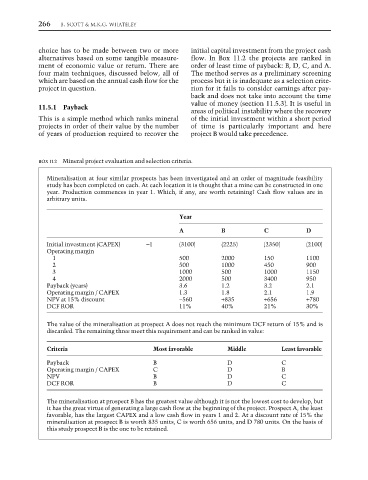
                  ment of economic value or return. There are  order of least time of payback: B, D, C, and A.
                  four main techniques, discussed below, all of  The method serves as a preliminary screening
                  which are based on the annual cash flow for the  process but it is inadequate as a selection crite-
                  project in question.                        rion for it fails to consider earnings after pay-
                                                              back and does not take into account the time
                                                              value of money (section 11.5.3). It is useful in
                  11.5.1 Payback
                                                              areas of political instability where the recovery
                  This is a simple method which ranks mineral  of the initial investment within a short period
                  projects in order of their value by the number  of time is particularly important and here
                  of years of production required to recover the  project B would take precedence.


                  BOX 11.2 Mineral project evaluation and selection criteria.

                    Mineralisation at four similar prospects has been investigated and an order of magnitude feasibility
                    study has been completed on each. At each location it is thought that a mine can be constructed in one
                    year. Production commences in year 1. Which, if any, are worth retaining? Cash flow values are in
                    arbitrary units.

                                                           Year

                                                           A           B            C           D
                    Initial investment (CAPEX)   −1        (3100)      (2225)       (2350)      (2100)
                    Operating margin
                      1                                    500         2000         150         1100
                      2                                    500         1000         450         900
                      3                                    1000        500          1000        1150
                      4                                    2000        500          3400        950
                    Payback (years)                        3.6         1.2          3.2         2.1
                    Operating margin / CAPEX               1.3         1.8          2.1         1.9
                    NPV at 15% discount                    −560        +835         +656        +780
                    DCF ROR                                11%         40%          21%         30%

                    The value of the mineralisation at prospect A does not reach the minimum DCF return of 15% and is
                    discarded. The remaining three meet this requirement and can be ranked in value:

                    Criteria                       Most favorable        Middle          Least favorable

                    Payback                        B                     D               C
                    Operating margin / CAPEX       C                     D               B
                    NPV                            B                     D               C
                    DCF ROR                        B                     D               C

                    The mineralisation at prospect B has the greatest value although it is not the lowest cost to develop, but
                    it has the great virtue of generating a large cash flow at the beginning of the project. Prospect A, the least
                    favorable, has the largest CAPEX and a low cash flow in years 1 and 2. At a discount rate of 15% the
                    mineralisation at prospect B is worth 835 units, C is worth 656 units, and D 780 units. On the basis of
                    this study prospect B is the one to be retained.

