


Page 286 - Introduction to Mineral Exploration
P. 286
11: PROJECT EVALUATION  269


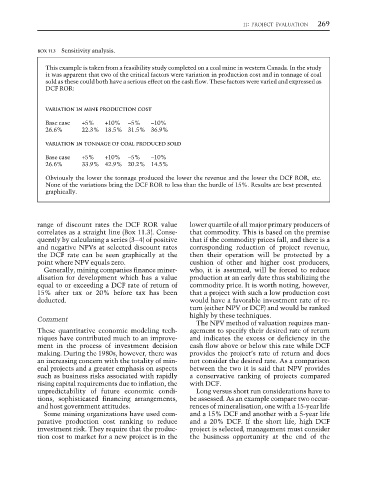
                 BOX 11.3 Sensitivity analysis.

                    This example is taken from a feasibility study completed on a coal mine in western Canada. In the study
                    it was apparent that two of the critical factors were variation in production cost and in tonnage of coal
                    sold as these could both have a serious effect on the cash flow. These factors were varied and expressed as
                    DCF ROR:


                    VARIATION IN MINE PRODUCTION COST
                    Base case  +5%   +10%   −5%    −10%
                    26.6%     22.3%  18.5% 31.5% 36.9%
                    VARIATION IN TONNAGE OF COAL PRODUCED SOLD

                    Base case  +5%   +10%   −5%    −10%
                    26.6%     33.9% 42.9% 20.2% 14.5%
                    Obviously the lower the tonnage produced the lower the revenue and the lower the DCF ROR, etc.
                    None of the variations bring the DCF ROR to less than the hurdle of 15%. Results are best presented
                    graphically.


                 range of discount rates the DCF ROR value    lower quartile of all major primary producers of
                 correlates as a straight line (Box 11.3). Conse-  that commodity. This is based on the premise
                 quently by calculating a series (3–4) of positive  that if the commodity prices fall, and there is a
                 and negative NPVs at selected discount rates  corresponding reduction of project revenue,
                 the DCF rate can be seen graphically at the  then their operation will be protected by a
                 point where NPV equals zero.                 cushion of other and higher cost producers,
                   Generally, mining companies finance miner-  who, it is assumed, will be forced to reduce
                 alisation for development which has a value  production at an early date thus stabilizing the
                 equal to or exceeding a DCF rate of return of  commodity price. It is worth noting, however,
                 15% after tax or 20% before tax has been     that a project with such a low production cost
                 deducted.                                    would have a favorable investment rate of re-
                                                              turn (either NPV or DCF) and would be ranked
                                                              highly by these techniques.
                 Comment
                                                                The NPV method of valuation requires man-
                 These quantitative economic modeling tech-   agement to specify their desired rate of return
                 niques have contributed much to an improve-  and indicates the excess or deficiency in the
                 ment in the process of investment decision   cash flow above or below this rate while DCF
                 making. During the 1980s, however, there was  provides the project’s rate of return and does
                 an increasing concern with the totality of min-  not consider the desired rate. As a comparison
                 eral projects and a greater emphasis on aspects  between the two it is said that NPV provides
                 such as business risks associated with rapidly  a conservative ranking of projects compared
                 rising capital requirements due to inflation, the  with DCF.
                 unpredictability of future economic condi-     Long versus short run considerations have to
                 tions, sophisticated financing arrangements,  be assessed. As an example compare two occur-
                 and host government attitudes.               rences of mineralisation, one with a 15-year life
                   Some mining organizations have used com-   and a 15% DCF and another with a 5-year life
                 parative production cost ranking to reduce   and a 20% DCF. If the short life, high DCF
                 investment risk. They require that the produc-  project is selected, management must consider
                 tion cost to market for a new project is in the  the business opportunity at the end of the

