


Page 292 - Introduction to Naval Architecture
P. 292
VIBRATION, NOISE AND SHOCK                  27?

        resort to physical modelling of parts of the ship to confirm results of
        finite element analyses. However the basic principles involved are not
        too difficult and these are explained.


        Simple vibrations

        The simplest case of oscillatory motion is where the restoring force
        acting on a body is proportional to its displacement from a position of
        stable equilibrium. This is the case of a mass on a spring which is the
        fundamental building block from which the response of complex
        structures can be arrived at, by considering them as combinations of
        many masses and springs. In the absence of any damping the body,
        once disturbed, would oscillate indefinitely. Its distance from the
        equilibrium position would vary sinusoidally and such motion is said to
        be simple harmonic. This type of motion was met earlier in the study of
        ship motions in still water. The presence of damping, due say to friction
        or viscous effects, causes the motion to die down with time. The motion
        is also affected by added mass effects due to the vibrating body
        interacting with the fluid around it. These are not usually significant for
        a body vibrating in air but in water they can be important There are
        many standard texts to which the reader can refer for a mathematical
        treatment of these motions. The important findings are merely
        summarized here.
          The motion is characterized by its amplitude, A, and period, T. For
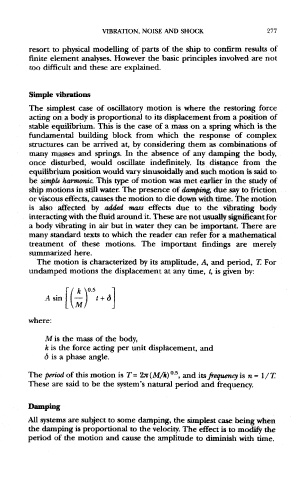
        undamped motions the displacement at any time, t, is given by:


        where:

             M is the mass of the body,
             k is the force acting per unit displacement, and
            d is a phase angle.

                                              5
        The period of this motion is T= 2n(M/K)°- , and its freqitency is n = l/T.
        These are said to be the system's natural period and frequency.

        Damping
        All systems are subject to some damping, the simplest case being when
        the damping is proportional to the velocity. The effect is to modify the
        period of the motion and cause the amplitude to diminish with time.

