


Page 125 - Introduction to Transfer Phenomena in PEM Fuel Cells
P. 125
114 Introduction to Transfer Phenomena in PEM Fuel Cells
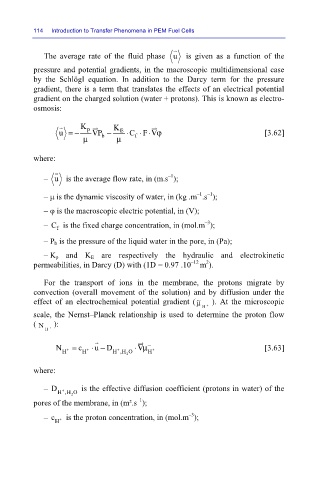
The average rate of the fluid phase u is given as a function of the
pressure and potential gradients, in the macroscopic multidimensional case
by the Schlögl equation. In addition to the Darcy term for the pressure
gradient, there is a term that translates the effects of an electrical potential
gradient on the charged solution (water + protons). This is known as electro-
osmosis:
K K
u =− p ∇ P − E ⋅ C ⋅ ⋅∇ϕ [3.62]
F
μ b μ f
where:
–1
– u is the average flow rate, in (m.s );
–1
–1
– μ is the dynamic viscosity of water, in (kg .m .s );
– φ is the macroscopic electric potential, in (V);
–3
– C is the fixed charge concentration, in (mol.m );
f
– P b is the pressure of the liquid water in the pore, in (Pa);
– K p and K E are respectively the hydraulic and electrokinetic
2
permeabilities, in Darcy (D) with (1D = 0.97 .10 –12 m ).
For the transport of ions in the membrane, the protons migrate by
convection (overall movement of the solution) and by diffusion under the
~
effect of an electrochemical potential gradient ( μ ). At the microscopic
H +
scale, the Nernst–Planck relationship is used to determine the proton flow
( N ):
H +
−
N + = c + ⋅ u D + ⋅∇μ − + [3.63]
H H H ,H O H
2
where:
– D + is the effective diffusion coefficient (protons in water) of the
H,H O
2
–1
pores of the membrane, in (m².s );
–3
– c + is the proton concentration, in (mol.m );
H

