


Page 130 - Introduction to Transfer Phenomena in PEM Fuel Cells
P. 130
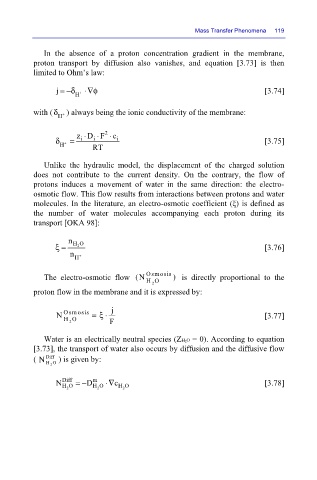
In the absence of a proton concentration gradient in the membrane,
                           proton transport by diffusion also vanishes, and equation [3.73] is then
                           limited to Ohm’s law:                      Mass Transfer Phenomena     119
                                 j =−δ  + ⋅∇φ                                            [3.74]
                                      H
                           with (δ  + ) always being the ionic conductivity of the membrane:
                                 H

                                              2
                                        ⋅
                                      zD F ⋅    c
                                            ⋅
                                 δ  + =  i  i    i                                       [3.75]
                                  H        RT
                             Unlike the hydraulic model, the displacement of the charged solution
                           does not contribute to the current density. On the contrary, the flow of
                           protons induces  a  movement of water  in the same direction: the electro-
                           osmotic flow. This flow results from interactions between protons and water
                           molecules. In the literature, an electro-osmotic coefficient (ξ) is defined as
                           the number  of water  molecules accompanying each proton during its
                           transport [OKA 98]:

                                    n HO
                                 ξ=   2                                                  [3.76]
                                    n  +
                                      H

                             The electro-osmotic flow  (N Osmosis )  is directly proportional to the
                                                         HO
                                                           2
                           proton flow in the membrane and it is expressed by:

                                 N  Osmosis  = ξ ⋅  j                                    [3.77]
                                   HO          F
                                    2
                             Water is an electrically neutral species (ZH 2 O = 0). According to equation
                           [3.73], the transport of water also occurs by diffusion and the diffusive flow
                           ( N  Diff  ) is given by:
                              H 2 O

                                 N Diff  =− D m 2  ⋅∇ c HO                               [3.78]
                                           H O
                                  HO
                                    2
                                                   2

