


Page 131 - Introduction to Transfer Phenomena in PEM Fuel Cells
P. 131
120     Introduction to Transfer Phenomena in PEM Fuel Cells
                           where:
                             –  D m 2   is the diffusion coefficient of the water in the membrane;
                                 HO
                             – c HO  is the water concentration in the membrane, it is related to the
                                  2
                           water content of the membrane (λ) by relation [3.81].
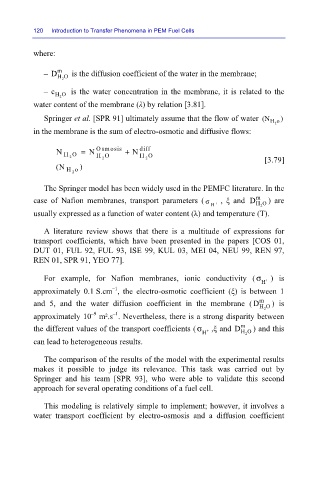
                             Springer et al. [SPR 91] ultimately assume that the flow of water  (N Ho )
                                                                                            2
                           in the membrane is the sum of electro-osmotic and diffusive flows:

                                 N  HO  =  N  Osmosis  +  N  diff
                                            HO
                                                       H O
                                    2
                                                         2
                                             2
                                 (N  Ho  )                                               [3.79]
                                     2
                             The Springer model has been widely used in the PEMFC literature. In the
                           case of Nafion membranes, transport parameters ( σ  + ,  ξ and  D m  ) are
                                                                           H           HO
                                                                                        2
                           usually expressed as a function of water content (λ) and temperature (T).
                             A literature review shows that there  is a  multitude of expressions for
                           transport coefficients, which have been presented in the papers  [COS 01,
                           DUT 01, FUL 92, FUL 93, ISE 99, KUL 03, MEI 04, NEU 99, REN 97,
                           REN 01, SPR 91, YEO 77].

                             For example, for Nafion  membranes, ionic conductivity ( σ   + ) is
                                                                                        H
                                                –1
                           approximately 0.1 S.cm , the electro-osmotic coefficient (ξ) is between 1
                           and 5, and the water diffusion coefficient in the  membrane ( D m 2  )  is
                                                                                        HO
                                                –1
                                          –9
                           approximately 10  m².s . Nevertheless, there is a strong disparity between
                           the different values of the transport coefficients ( σ  + ,ξ and  D m  ) and this
                                                                        H          HO
                                                                                    2
                           can lead to heterogeneous results.
                             The comparison of the results of the model with the experimental results
                           makes it possible to judge  its  relevance. This task was carried out by
                           Springer and his team  [SPR 93], who were able to validate this second
                           approach for several operating conditions of a fuel cell.

                             This modeling is relatively simple to implement; however, it involves a
                           water transport coefficient by electro-osmosis and a diffusion  coefficient

