


Page 246 -
P. 246
243_MasterPieces_04c.qxd  4/22/03  1:18 PM  Page 218


           218    Masterpiece 4 • PneumADDic II
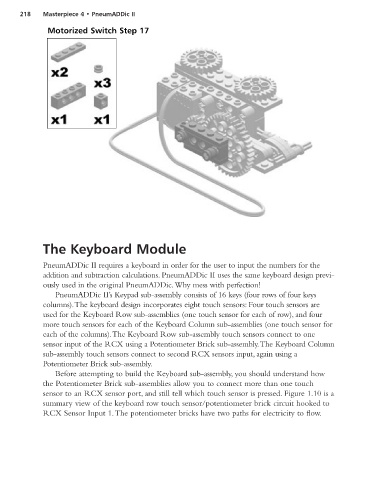
                   Motorized Switch Step 17


                  The Keyboard Module


                  PneumADDic II requires a keyboard in order for the user to input the numbers for the
                  addition and subtraction calculations. PneumADDic II uses the same keyboard design previ-
                  ously used in the original PneumADDic.Why mess with perfection!
                      PneumADDic II’s Keypad sub-assembly consists of 16 keys (four rows of four keys
                  columns).The keyboard design incorporates eight touch sensors: Four touch sensors are
                  used for the Keyboard Row sub-assemblies (one touch sensor for each of row), and four
                  more touch sensors for each of the Keyboard Column sub-assemblies (one touch sensor for
                  each of the columns).The Keyboard Row sub-assembly touch sensors connect to one
                  sensor input of the RCX using a Potentiometer Brick sub-assembly.The Keyboard Column
                  sub-assembly touch sensors connect to second RCX sensors input, again using a
                  Potentiometer Brick sub-assembly.
                      Before attempting to build the Keyboard sub-assembly, you should understand how
                  the Potentiometer Brick sub-assemblies allow you to connect more than one touch
                  sensor to an RCX sensor port, and still tell which touch sensor is pressed. Figure 1.10 is a
                  summary view of the keyboard row touch sensor/potentiometer brick circuit hooked to
                  RCX Sensor Input 1.The potentiometer bricks have two paths for electricity to flow.

