


Page 179 - Materials Chemistry, Second Edition
P. 179
164   LIFE CYCLE ASSESSMENT HANDBOOK

              and total dry matter. Moreover, even the same content of nutrients can be used
              in various ways (Marshall, 2001).
                 The study  of Notarnicola  et ah (Notarnicola, et ah 2010) on wine shows just
              some  of the elements  outlined  above. Different  from  what  could  be  thought,
              wine production  is a complex activity in which the technology plays the same
              important role of the grape cultivation and  of the winemaker skills. Even if the
              raw materials are only grapes, yeast and some chemicals, the possible alterna-
              tive  processes  are  so  many  that  the  produced  wine  can  have  very  different
              quality  levels  (Notarnicola, et ah 2003). The results  of the study  showed  how
              much the results could change if a different  functional unit is used and how the
              environmental  performance  of wine production  changes  if more  technologies
              are used  in  order  to obtain  a higher  quality wine. Moreover, the use  of  tech-
              nology made   to increase the quality  of wine and  to avoid  defects  could  lead
              to a higher  consumption  of  energy, materials and  chemicals that, in terms  of
              LCA, could mean higher environmental    impact.
                 Despite  the  great  variety  of  wines, most  of  the  LCA studies  of  wine  and,
              above  all,  those  ones  with  comparative  aims,  artificially  consider  the  final
              products as having the same characteristics. As a consequence, the  functional
              unit used is a specific amount  of product in litres or kilograms, without any ref-
              erence to the main characteristics  of products. Product Category Rules (PCRs)
              regarding  environmental  product  declaration  (EPD)  for  packaged  sparkling
              red,  white  and  rose  wines  also  suggest  as  functional  unit  one  litre  of  wine
              (Swedish-Environmental-Management-Council,     2006).
                 As expected, by  including  more  technology  in  order  to produce  a  quality
              wine gives the result  of a worse environmental performance  if the comparison
              is made  on  the basis  of  volume  or  mass.  By considering  a  different  function
              of  the  system,  such  as the  production  of  a beverage  with  a  certain  alcoholic
              degree  or  a  certain  hedonistic  value  (the hedonistic  value  is an  index  which
              measures  the  main  characteristics  of  wine  based  on  the  traditional  descrip-
              tors  of the sensory  feedback),  and,  consequently, using  a  different  functional
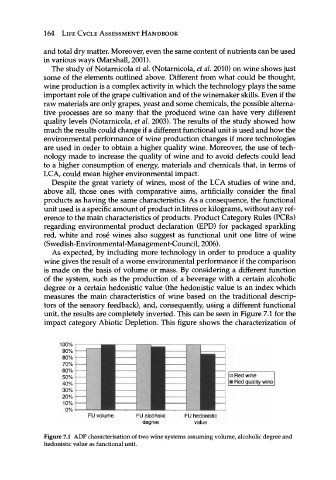
              unit, the results are completely inverted. This can be seen in Figure  7.1 for the
              impact  category Abiotic Depletion.  This  figure shows the  characterization  of


                   100%
                    90%
                    80%
                    70%
                    60%
                    50%
                    40%
                    30%
                    20%
                    10%
                     0%
                           FU volume      FU alcoholic  FU hedonistic
                                            degree         value
              Figure  7.1  ADP characterisation  of two wine systems assuming volume, alcoholic degree  and
              hedonistic  value as functional  unit.

