


Page 234 - Materials Chemistry, Second Edition
P. 234
ACCOUNTING FOR ECOSYSTEM GOODS AND SERVICES         221

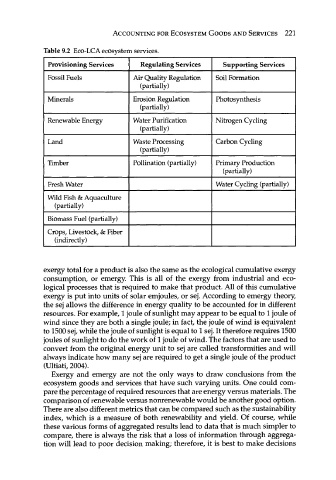
              Table 9.2 Eco-LCA ecosystem services.
               Provisioning Services       Regulating Services      Supporting Services

               Fossil Fuels              Air Quality Regulation   Soil Formation
                                           (partially)

               Minerals                  Erosion Regulation       Photosynthesis
                                           (partially)

               Renewable Energy          Water Purification       Nitrogen Cycling
                                           (partially)

               Land                      Waste Processing         Carbon Cycling
                                           (partially)

               Timber                    Pollination (partially)   Primary Production
                                                                    (partially)

               FreshWater                                         Water Cycling (partially)
               Wild Fish & Aquaculture
                 (partially)
               Biomass Fuel (partially)

               Crops, Livestock, & Fiber
                 (indirectly)


              exergy total for a product is also the same as the ecological cumulative exergy
              consumption, or emergy. This is all of the exergy from industrial and eco-
              logical processes that is required to make that product. All of this cumulative
              exergy is put into units of solar emjoules, or sej. According to emergy theory,
              the sej allows the difference in energy quality to be accounted for in different
              resources. For example, 1 joule of sunlight may appear to be equal to 1 joule of
              wind since they are both a single joule; in fact, the joule of wind is equivalent
              to 1500 sej, while the joule of sunlight is equal to 1 sej. It therefore requires 1500
              joules of sunlight to do the work of 1 joule of wind. The factors that are used to
              convert from the original energy unit to sej are called transformities and will
              always indicate how many sej are required to get a single joule of the product
              (Ultiati, 2004).
                Exergy and emergy are not the only ways to draw conclusions from the
              ecosystem goods and services that have such varying units. One could com-
              pare the percentage of required resources that are energy versus materials. The
              comparison of renewable versus nonrenewable would be another good option.
              There are also different metrics that can be compared such as the sustainability
              index, which is a measure of both renewability and yield. Of course, while
              these various forms of aggregated results lead to data that is much simpler to
              compare, there is always the risk that a loss of information through aggrega-
              tion will lead to poor decision making; therefore, it is best to make decisions

