


Page 203 - Machine Learning for Subsurface Characterization
P. 203
Dimensionality reduction and clustering techniques Chapter  6 173


             When the MMP is higher than the reservoir pressure, a portion of free oil cannot
             achieve miscibility during the injection, which is possible for free oil residing in
             larger pores. High MMP reduces the displacement efficiency of light-
             hydrocarbon injection. The amount of oil that can achieve miscibility under
             reservoir condition is a direct measure of displacement efficiency.
                To estimate the volume fraction of free oil that can achieve miscibility in the
             presence of pore-confinement effect, the pore size distribution of a formation is
             first calculated from the measured NMR T2 distribution. The T2 relaxation
             captured in the NMR measurement (Fig. 6.5, Track 1) is a sum of bulk fluid
             relaxation, molecular relaxation, and surface relaxation. T2 distribution
             represents pore size distribution because the surface relaxation is
             proportional to the surface-to-volume ratio and surface relaxivity. In tight
             formation, where pore size is small and the pore is filled with light oil, the
             bulk relaxation and molecular diffusion effect can be neglected [34, 35].
             Based on this assumption the T2 response is associated with pore diameter
             by using the surface relaxivity expressed as

                                         1       6
                                              ¼ ρ                       (6.6)
                                       T 2, Surface  d
             where T 2, surface is the surface relaxation in ms, ρ is surface relaxivity in nm/ms,
             and d is pore body diameter in nanometers.
                The middle shale has larger pore throat and pore diameter than the upper and
             lower shales. In the absence of SEM image, we refer to the literature and the
             maximum throat size in the middle section is assumed to be around 100 nm
             [36], and the maximum pore body size in the middle section is assumed to
             be around 1000 nm [37]. Similarly, the pore throat size in upper and lower
             sections is assumed to be around 25 nm [14]. We assume that the body size-
             to-throat size ratio in the upper and lower shales is equal to that in the
             middle section. From the NMR T2 distribution log, the maximum T2 value
             of upper and lower shale sections is 30 ms, and that in the middle section is
             300 ms. Jiang et al.’s [34] method was then used to estimate the surface
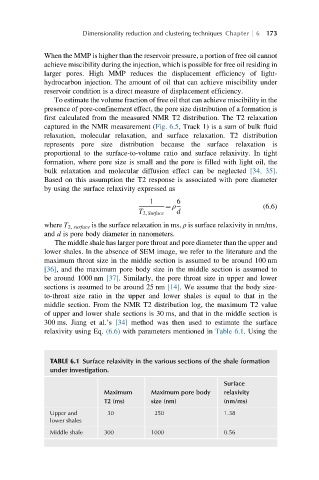
             relaxivity using Eq. (6.6) with parameters mentioned in Table 6.1. Using the


               TABLE 6.1 Surface relaxivity in the various sections of the shale formation
               under investigation.
                                                              Surface
                             Maximum      Maximum pore body   relaxivity
                             T2 (ms)      size (nm)           (nm/ms)
               Upper and      30           250                1.38
               lower shales
               Middle shale  300          1000                0.56

