


Page 293 - Making PIC Microcontroller Instruments and Controllers
P. 293
294   SIIIGLE SET POIIIT  COI{TROIIER W|rH NEMOTE II{HIBIT CAPABII.ITY


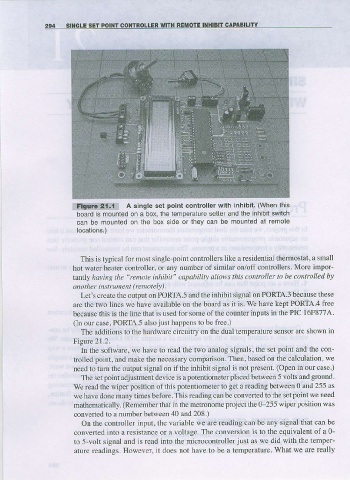
                     lf!lt$*q!!!i   A single set  point  controller  with inhibit.  (When  this
                      board is mounled  on a box, the lemoe|aiure  selter and the  inhibil swilch
                      can be mounted  on lhe box side of lhey can be mounted  at remote
                      locations.)


                       This is typical for most singlc-point  controllers like a residential themostat, a small
                     hot water heater  controller, or any number of similar on/off conhollers. More impor_
                                    "renote
                     t^niy  haviftB the    inhibit"  capability allows this controller to be co  trolled bJ
                                      (remoteh).
                     another i strument
                       Let's create the outp t on PORIAs  and the  inhibit signal on PORTA.3  because these
                     arc the two lines we have  available on the board  as it is. We have  kept PORIA4  free
                                            j
                     because  this is the line ihat  s used  for some of the counter  inputs in the  PIC 16F877A.
                     (In  ourcase,  PORIA5 alsojust  happens to be fiee.)
                       The additions  to the hadware circuitry on the dual temperature  sensor arc shown  in
                     Figre  27.2.
                       In the software,  we have to rcad the two analog sigllals,  the set  point and  the con-
                     trolled  point,  and rnake  the necessary comparison.  Then, based on the calculation,  we
                     need to turn the output sigral on if the inhibit signal  is not present (Open  in our case  )
                       The set  point adjustment device  is a  potentiometer  placed  between 5 volts and  ground.
                     We rcad the wr!€r position of this potertiometer to get a reading between 0 and 255 as
                     we have done  many times before. This reading can be converted  to the set  point we need
                     mathematically.  (Remember  that  in the metronome  project  the 0-255 wiper  posinon  was
                     converted to a number betwe€n 40 and  208.)
                        On fhe controller  input, the variable  we are reading can be any signal that  can be
                     convefieal into a resistance  or a voltage. The  conversion is to the  equivalent of a 0-
                     to 5-volt signal and  is read into the microcontrollerjust  as we did with the temper-
                      ature  readings. However,  it does not have to be a temperature What  we are really

