


Page 306 - Making PIC Microcontroller Instruments and Controllers
P. 306
soa   ToGGNG  DATA Fnoii  A SOIAR  COLIECIIB


                      As  pmErammell for rhis expeiment, the clock is set  to 0 t Jan,  2007 on sta  up, and
                    after  every  power failure, lt can, of course, be set to any  date and time you choose,  and
                    it will not aflect the  results of our experiments  in that we are not using the  exact lime/date
                    information as such, but rather the daily cycle of the collected  daia. Even  missing a day
                    or two of data  would not adversely  affect our effort.
                      We have no way of intervening to set lhe clock iflwhen there  is a power iailure, so
                    we set the clock to the beginning of the year 200? on startup and  whenever there  is a
                    power  failure. Later on, when the dala  is analyzed, we car use the temperature  data and
                    number  of data  points since the last night cycle to determine  the approximate  time of
                                                                                       js
                    day  for each recovery.  Fortunately, the exact time at  which the readings  are laken  not
                    impo(ant  ir this  pa  icular  investigation.

                     Nole  Therc  is a ptur,ision.for  a battery backlp  far   the clock on the I'AB'XI ,  atul a bst
                    tery could be  pmviAed  tu keep  the clock  Eoing  d  ring po\rer  failurcs  if this v/as  desircd
                    However, chances  are, the bafteies will rnt be easily  aNailable in nnny parts ofthe less'
                    det,eloped  worl(l wherc  data mhf  be  7athercd,  so t')e shoud take that  into consi.leration
                       The  "date  data'  does not show up on the display  but is sent to the computer  along
                     with the other data as  a matter of course  during each transmission  to the PC
                       The  clock is seen as a set  of memory  locations by the MCU  The ac$al locations will
                     depend on the clock cbip we select. For this application, we have selected the  Nru6355
                     IC chip. The use  of this chip  is explained in some  detail in Cbapter  7. We read the  clock
                     bur  rhe exacl acruai  time  is not ol;nFre\l beLau\e  \ e do not ha\e a  wa) lo reiel lo  lhe cof-
                     rect time  after a  power  failure. Our interest  is in the time  that has elapsed  since the last  sun-
                     rise and  since the last  power  failwe. We can  estimate the actual  iime from the inldmation
                     gathered  for the day if we know the lirst date that the data  was collected.  (The program
                     segment  to read the IC is taten from a  program  on the microEngineering  Labs  Web site.)
                       The routrne  to send the data  to the computer  look  at the seconds  value, and  then every
                     minute, based on the changes  in the registe(s, it sends  the relevant  information to the
                     computer  lor storage.
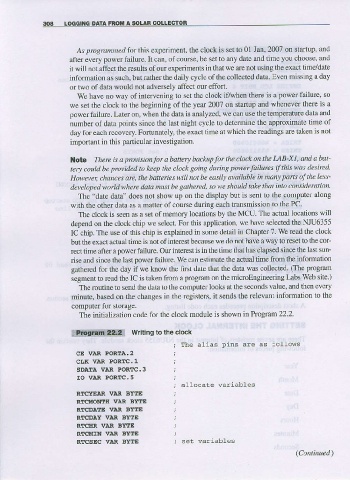
                       The initialization code for the clock module is shown  in Program  22 2

                     ii8iiiiil$lt*i.8:   writins to the crock
                                                 ;  The  alias   Pins  are  as  follows
                      CE  VI*   POREA.2
                      CI,K  VAR  PORTC.I
                      SDA'A  VAR  PORTC.3
                      IO  VAl'  PORTC.s
                                                 ;  allocate   wariabLes
                      RTCYEIIR  1IAR  BYTE
                      RTCIIOIf,IH  1IAR  B'TE
                      RICDAIPE  VAR  EYTB
                      RTCDAY  VAR  BT4!E
                      RTCITR  VAR  BIEE
                      RTCMIN  1IAR  BITE
                      RICSEC  vaR  AYIE          ;  set  variables
                                                                                   (Contin  edt

