


Page 152 - Making things move_ DIY mechanisms for inventors, hobbyists, and artists
P. 152
132        Making Things Move


               that has higher torque, but turns slower. How much slower depends on the gear
               ratio. This should sound familiar from earlier chapters that talked about mechanical
               advantage. Here, we’re trading speed for torque: a 100:1 gearhead ratio will give us
               100 times more torque than without the gears, but also will be 100 times slower. DC
               gearhead motors usually range from about 3V to 30V and run at speeds from less
               than 1 rpm to a few hundred rpm.

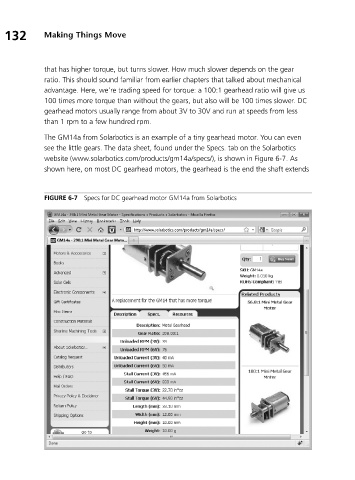
               The GM14a from Solarbotics is an example of a tiny gearhead motor. You can even
               see the little gears. The data sheet, found under the Specs. tab on the Solarbotics
               website (www.solarbotics.com/products/gm14a/specs/), is shown in Figure 6-7. As
               shown here, on most DC gearhead motors, the gearhead is the end the shaft extends


               FIGURE 6-7 Specs for DC gearhead motor GM14a from Solarbotics

