


Page 265 - Managing Global Warming
P. 265
222                                               Managing Global Warming

         to International Energy Agency (IEA) statistics [4], total primary energy had risen to
         574EJ, with only 67EJ from renewable energy (RE) sources, mostly biomass used as
         heating and cooking fuel in low-income countries.
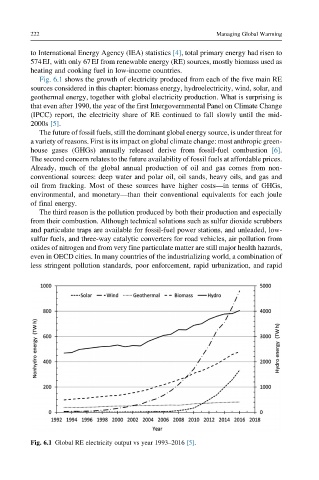
            Fig. 6.1 shows the growth of electricity produced from each of the five main RE
         sources considered in this chapter: biomass energy, hydroelectricity, wind, solar, and
         geothermal energy, together with global electricity production. What is surprising is
         that even after 1990, the year of the first Intergovernmental Panel on Climate Change
         (IPCC) report, the electricity share of RE continued to fall slowly until the mid-
         2000s [5].
            The future of fossil fuels, still the dominant global energy source, is under threat for
         a variety of reasons. First is its impact on global climate change: most anthropic green-
         house gases (GHGs) annually released derive from fossil-fuel combustion [6].
         The second concern relates to the future availability of fossil fuels at affordable prices.
         Already, much of the global annual production of oil and gas comes from non-
         conventional sources: deep water and polar oil, oil sands, heavy oils, and gas and
         oil from fracking. Most of these sources have higher costs—in terms of GHGs,
         environmental, and monetary—than their conventional equivalents for each joule
         of final energy.
            The third reason is the pollution produced by both their production and especially
         from their combustion. Although technical solutions such as sulfur dioxide scrubbers
         and particulate traps are available for fossil-fuel power stations, and unleaded, low-
         sulfur fuels, and three-way catalytic converters for road vehicles, air pollution from
         oxides of nitrogen and from very fine particulate matter are still major health hazards,
         even in OECD cities. In many countries of the industrializing world, a combination of
         less stringent pollution standards, poor enforcement, rapid urbanization, and rapid


         Fig. 6.1 Global RE electricity output vs year 1993–2016 [5].

