


Page 663 - 04. Subyek Engineering Materials - Manufacturing, Engineering and Technology SI 6th Edition - Serope Kalpakjian, Stephen Schmid (2009)
P. 663
Chapter 23  Machining Processes: Turning and Hole Making

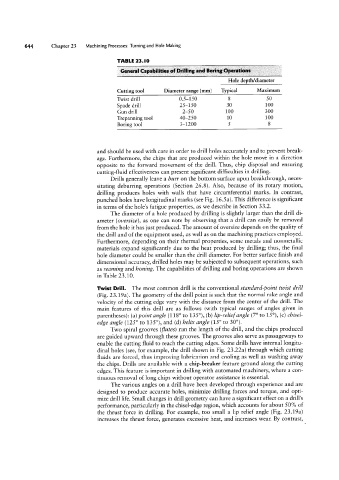
                                          TABLE 23.I0
                                           General Capabiiities of Drilling and Bering Operations
                                                                                 Hole depth/diameter
                                          Cutting tool     Diameter range (mm)  Typical    Maximum
                                          Twist drill           0.5-150          8            50
                                          Spade drill           25-150          30            100
                                          Gun drill              2-50           100           300
                                          Trepanning tool       40-250          10            100
                                          Boring tool           3-1200           S             8


                                   and should be used with care in order to drill holes accurately and to prevent break-
                                   age. Furthermore, the chips that are produced within the hole move in a direction
                                   opposite to the forward movement of the drill. Thus, chip disposal and ensuring
                                   cutting-fluid effectiveness can present significant difficulties in drilling.
                                        Drills generally leave a hurr on the bottom surface upon breakthrough, neces-
                                   sitating deburring operations (Section 26.8). Also, because of its rotary motion,
                                   drilling produces holes with walls that have circumferential marks. In contrast,
                                   punched holes have longitudinal marks (see Fig. 16.5a). This difference is significant
                                   in terms of the hole’s fatigue properties, as we describe in Section 33.2.
                                        The diameter of a hole produced by drilling is slightly larger than the drill di-
                                   ameter (oz/ersize), as one can note by observing that a drill can easily be removed
                                   from the hole it has just produced. The amount of oversize depends on the quality of
                                   the drill and of the equipment used, as well as on the machining practices employed.
                                   Furthermore, depending on their thermal properties, some metals and nonmetallic
                                   materials expand significantly due to the heat produced by drilling; thus, the final
                                   hole diameter could be smaller than the drill diameter. For better surface finish and
                                   dimensional accuracy, drilled holes may be subjected to subsequent operations, such
                                   as rearning and honing. The capabilities of drilling and boring operations are shown
                                   in Table 23.10.

                                   Twist Drill.  The most common drill is the conventional standard-point twist drill
                                   (Fig. 23.19a). The geometry of the drill point is such that the normal rake angle and
                                   velocity of the cutting edge vary with the distance from the center of the drill. The
                                   main features of this drill are as follows (with typical ranges of angles given in
                                   parentheses): (a) point angle (118° to 135°), (b) lip-reliefangle (7° to 15°), (c) chisel-
                                   edge angle (125° to 135°), and (d) helix angle (15° to 30°).
                                        Two spiral grooves (flutes) run the length of the drill, and the chips produced
                                   are guided upward through these grooves. The grooves also serve as passageways to
                                   enable the cutting fluid to reach the cutting edges. Some drills have internal longitu-
                                   dinal holes (see, for example, the drill shown in Fig. 23.22a) through which cutting
                                   fluids are forced, thus improving lubrication and cooling as well as washing away
                                   the chips. Drills are available with a chip-breaker feature ground along the cutting
                                   edges. This feature is important in drilling with automated machinery, where a con-
                                   tinuous removal of long chips without operator assistance is essential.
                                        The various angles on a drill have been developed through experience and are
                                   designed to produce accurate holes, minimize drilling forces and torque, and opti-
                                   mize drill life. Small changes in drill geometry can have a significant effect on a drill’s
                                   performance, particularly in the chisel-edge region, which accounts for about 50% of
                                   the thrust force in drilling. For example, too small a lip relief angle (Fig. 23.19a)
                                   increases the thrust force, generates excessive heat, and increases wear. By contrast,

