


Page 664 - 04. Subyek Engineering Materials - Manufacturing, Engineering and Technology SI 6th Edition - Serope Kalpakjian, Stephen Schmid (2009)
P. 664
Section 23.5
                                                                         ga
              too large an angle can cause chipping or                                   E,
                                                                              g
              breaking of the cutting edge. In addition to         2°   E                E
                                                                                         ':
              conventional point drills, several other   O)             g                'E
              drill-point geometries have been developed      9    E    Y;    ‘g    g    .2
              to improve drill performance and increase  'E  8     53   8     8     gg   8          High-pressure
              the penetration rate. Special grinding tech-                                          coolant
              niques and equipment are used to produce
              these geometries.
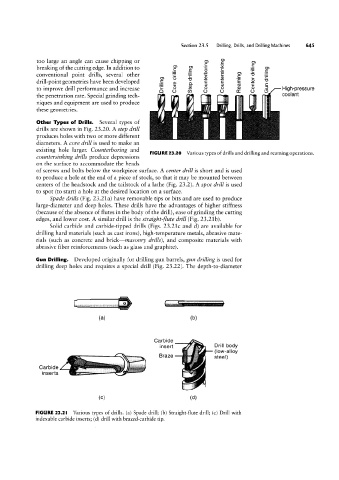
              Other Types of Drills.  Several types of
              drills are shown in Fig. 23.20. A step drill
              produces holes with two or more different
              diameters. A core drill is used to make an
              existing hole larger. Counterboring and
                                                     FIGURE 23.20  Various types of drills and drilling and reaming operations.
              countersinking drills produce depressions
              on the surface to accommodate the heads
              of screws and bolts below the workpiece surface. A center drill is short and is used
              to produce a hole at the end of a piece of stock, so that it may be mounted between
              centers of the headstock and the tailstock of a lathe (Fig. 23.2). A spot drill is used
              to spot (to start) a hole at the desired location on a surface.
                  Spade drills (Fig. 23.21a) have removable tips or bits and are used to produce
              large-diameter and deep holes. These drills have the advantages of higher stiffness
              (because of the absence of flutes in the body of the drill), ease of grinding the cutting
              edges, and lower cost. A similar drill is the straight-flute drill (Fig. 23.21b).
                  Solid carbide and carbide-tipped drills (Figs. 23.21c and d) are available for
              drilling hard materials (such as cast irons), high-temperature metals, abrasive mate-
              rials (such as concrete and brick-masonry drills), and composite materials with
              abrasive fiber reinforcements (such as glass and graphite).
               Camei
              Gun Drilling.  Developed originally for drilling gun barrels, gun drilling is used for
              drilling deep holes and requires a special drill (Fig. 23.22). The depth-to-diameter


                                           ’é"""3\&


                                                                    (D)
                                    (G)                  insert
                                                         Braze
                          o   .
                                                       Carbide
                                                                            Drill body
                                                                            (lowlalloy
                               ..._
                                             .fi
                inserts      .......    .....  ,  .,,..,.          (vi,
                                                                 ,_


                                    (C)                             (fi)

             FIGURE 23.2I  Various types of drills. (a) Spade drill; (b) Straight-flute drill; (c) Drill with
             indexable carbide inserts; (d) drill with brazed-carbide tip.


                                                                             S
                                                                              :.
                                                                               §
                                                                                 9°
                                                                                   YJ
                                                                                    :_
                                                                                     F
                                                                                       Q)
                                                                                        :a
                                                                                         cz.
                                                                                           U
                                                                                            :.
                                                                                             ET
                                                                                              und
                                                                                              rilling
                                                                                               un
                                                                                                §
                                                                                                 Q1
                                                                                                  (5
                                                                                                   Ei
                                                                                                    :s
                                                                                                     (D
                                                                                                      U)
                                                                                                            ¢\
                                                                                                             -5
                                                                                                              U\

