


Page 106 - Marketing Management
P. 106
COLLECTING INFORMATION AND FORECASTING DEMAND | CHAPTER 3             83


           and matched that with a green product with a very modest price pre-
           mium and sold through a grassroots marketing program.
               Environmental concerns are affecting how virtually every major
           company does their business: Walt Disney Corp. has pledged to reduce
           its solid waste by 2013, conserve millions of gallons of water, invest in
           renewable energy, and become completely carbon neutral (reaching
           50 percent of that goal by 2012); Best Buy has expanded its recycling
           program for electronics; Caterpillar announced plans to reduce the GHG
           emissions of its entire product line by 20 percent by 2020; and Whole
           Foods, a leader among national supermarket chains in selling certified
           “organic food” already, cofounded a partnership to reduce emissions
           from grocery refrigerators and offsets 100 percent of its electricity use
           with renewable energy via wind-energy credits.
               Toyota, HP, IKEA, Procter & Gamble, and Walmart have all been linked
           to high-profile environmental and sustainability programs. Some other
           marketers, fearing harsh scrutiny or unrealistic expectations, keep a lower
           profile. Even though Nike uses recycled sneakers in its soles of new shoes,
           they chose not to publicize that fact so that they can keep their focus on per-
           formance and winning.The rules of the game in green marketing are chang-
           ing rapidly as both consumers and companies respond to problems and
           proposed solutions to the significant environmental problems that exist.

           Sources: Jerry Adler, “Going Green,” Newsweek, July 17, 2006, pp. 43–52;
           Jacquelyn A. Ottman, Edwin R. Stafford, and Cathy L. Hartman, “Avoiding Green
           Marketing Myopia,” Environment (June 2006): 22–36; Jill Meredith Ginsberg and
           Paul N. Bloom, “Choosing the Right Green Marketing Strategy,” MIT Sloan
           Management Review (Fall 2004): 79–84; Jacquelyn Ottman, Green Marketing:
           Opportunity for Innovation, 2nd ed. (New York: BookSurge Publishing, 2004); Mark
           Dolliver, “Deflating a Myth,”Brandweek, May 12, 2008, pp. 30–31; “Winner:
           Corporate Sustainability, Walt Disney Worldwide,” Travel and Leisure, November
           2009, p. 106; “The Greenest Big Companies in America, Newsweek, September 28,
           2009, pp. 34–53; Sarah Mahoney, “Best Buy Connects Green with Thrift,” Media
           Post News: Marketing Daily, January 28, 2009; Reena Jana, “Nike Quietly Goes
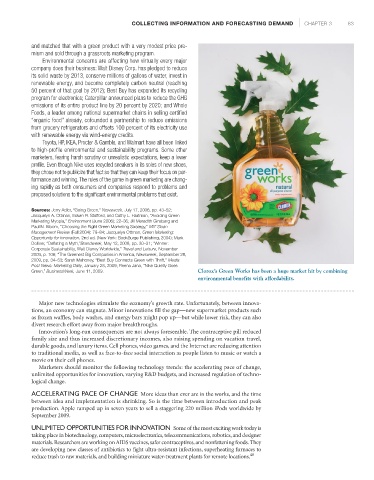
           Green,” BusinessWeek, June 11, 2009.                  Clorox’s Green Works has been a huge market hit by combining
                                                                 environmental benefits with affordability.


              Major new technologies stimulate the economy’s growth rate. Unfortunately, between innova-
           tions, an economy can stagnate. Minor innovations fill the gap—new supermarket products such
           as frozen waffles, body washes, and energy bars might pop up—but while lower risk, they can also
           divert research effort away from major breakthroughs.
              Innovation’s long-run consequences are not always foreseeable. The contraceptive pill reduced
           family size and thus increased discretionary incomes, also raising spending on vacation travel,
           durable goods, and luxury items. Cell phones, video games, and the Internet are reducing attention
           to traditional media, as well as face-to-face social interaction as people listen to music or watch a
           movie on their cell phones.
              Marketers should monitor the following technology trends: the accelerating pace of change,
           unlimited opportunities for innovation, varying R&D budgets, and increased regulation of techno-
           logical change.
           ACCELERATING PACE OF CHANGE More ideas than ever are in the works, and the time
           between idea and implementation is shrinking. So is the time between introduction and peak
           production. Apple ramped up in seven years to sell a staggering 220 million iPods worldwide by
           September 2009.
           UNLIMITED OPPORTUNITIES FOR INNOVATION Some of the most exciting work today is
           taking place in biotechnology,computers,microelectronics,telecommunications,robotics,and designer
           materials.Researchers are working on AIDS vaccines,safer contraceptives,and nonfattening foods.They
           are developing new classes of antibiotics to fight ultra-resistant infections, superheating furnaces to
           reduce trash to raw materials, and building miniature water-treatment plants for remote locations. 48

