


Page 430 - Marketing Management
P. 430
DEVELOPING PRICING STRATEGIES AND PROGRAMS | CHAPTER 14           407


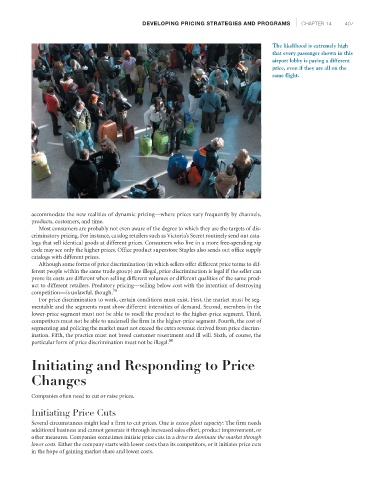
                                                                                         The likelihood is extremely high
                                                                                         that every passenger shown in this
                                                                                         airport lobby is paying a different
                                                                                         price, even if they are all on the
                                                                                         same flight.


           accommodate the new realities of dynamic pricing—where prices vary frequently by channels,
           products, customers, and time.
              Most consumers are probably not even aware of the degree to which they are the targets of dis-
           criminatory pricing. For instance, catalog retailers such as Victoria’s Secret routinely send out cata-
           logs that sell identical goods at different prices. Consumers who live in a more free-spending zip
           code may see only the higher prices. Office product superstore Staples also sends out office supply
           catalogs with different prices.
              Although some forms of price discrimination (in which sellers offer different price terms to dif-
           ferent people within the same trade group) are illegal, price discrimination is legal if the seller can
           prove its costs are different when selling different volumes or different qualities of the same prod-
           uct to different retailers. Predatory pricing—selling below cost with the intention of destroying
           competition—is unlawful, though. 79
              For price discrimination to work, certain conditions must exist. First, the market must be seg-
           mentable and the segments must show different intensities of demand. Second, members in the
           lower-price segment must not be able to resell the product to the higher-price segment. Third,
           competitors must not be able to undersell the firm in the higher-price segment. Fourth, the cost of
           segmenting and policing the market must not exceed the extra revenue derived from price discrim-
           ination. Fifth, the practice must not breed customer resentment and ill will. Sixth, of course, the
           particular form of price discrimination must not be illegal. 80


           Initiating and Responding to Price

           Changes


           Companies often need to cut or raise prices.

           Initiating Price Cuts
           Several circumstances might lead a firm to cut prices. One is excess plant capacity: The firm needs
           additional business and cannot generate it through increased sales effort, product improvement, or
           other measures. Companies sometimes initiate price cuts in a drive to dominate the market through
           lower costs. Either the company starts with lower costs than its competitors, or it initiates price cuts
           in the hope of gaining market share and lower costs.

