


Page 431 - Marketing Management
P. 431
408    PART 5    SHAPING THE MARKET OFFERINGS


                                        Cutting prices to keep customers or beat competitors often encourages customers to demand
                                                                                      81
                                      price concessions, however, and trains salespeople to offer them. A price-cutting strategy can lead
                                      to other possible traps:
                                      •  Low-quality trap. Consumers assume quality is low.
                                      •  Fragile-market-share trap. A low price buys market share but not market loyalty. The same
                                         customers will shift to any lower-priced firm that comes along.
                                      •  Shallow-pockets trap. Higher-priced competitors match the lower prices but have longer
                                         staying power because of deeper cash reserves.
                                      •  Price-war trap. Competitors respond by lowering their prices even more, triggering a price war. 82
                                                                                        83
                                        Customers often question the motivation behind price changes. They may assume the item is
                                      about to be replaced by a new model; the item is faulty and is not selling well; the firm is in finan-
                                      cial trouble; the price will come down even further; or the quality has been reduced. The firm must
                                      monitor these attributions carefully.

                                      Initiating Price Increases
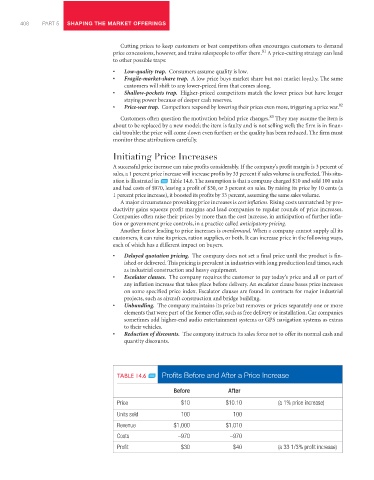
                                      A successful price increase can raise profits considerably. If the company’s profit margin is 3 percent of
                                      sales, a 1 percent price increase will increase profits by 33 percent if sales volume is unaffected. This situ-
                                      ation is illustrated in   Table 14.6. The assumption is that a company charged $10 and sold 100 units
                                      and had costs of $970, leaving a profit of $30, or 3 percent on sales. By raising its price by 10 cents (a
                                      1 percent price increase), it boosted its profits by 33 percent, assuming the same sales volume.
                                        A major circumstance provoking price increases is cost inflation. Rising costs unmatched by pro-
                                      ductivity gains squeeze profit margins and lead companies to regular rounds of price increases.
                                      Companies often raise their prices by more than the cost increase, in anticipation of further infla-
                                      tion or government price controls, in a practice called anticipatory pricing.
                                        Another factor leading to price increases is overdemand. When a company cannot supply all its
                                      customers, it can raise its prices, ration supplies, or both. It can increase price in the following ways,
                                      each of which has a different impact on buyers.
                                      •  Delayed quotation pricing. The company does not set a final price until the product is fin-
                                         ished or delivered. This pricing is prevalent in industries with long production lead times, such
                                         as industrial construction and heavy equipment.
                                      •  Escalator clauses. The company requires the customer to pay today’s price and all or part of
                                         any inflation increase that takes place before delivery. An escalator clause bases price increases
                                         on some specified price index. Escalator clauses are found in contracts for major industrial
                                         projects, such as aircraft construction and bridge building.
                                      •  Unbundling. The company maintains its price but removes or prices separately one or more
                                         elements that were part of the former offer, such as free delivery or installation. Car companies
                                         sometimes add higher-end audio entertainment systems or GPS navigation systems as extras
                                         to their vehicles.
                                      •  Reduction of discounts. The company instructs its sales force not to offer its normal cash and
                                         quantity discounts.


                                       TABLE 14.6    Profits Before and After a Price Increase
                                                         Before            After

                                       Price                $10           $10.10           (a 1% price increase)
                                       Units sold           100             100

                                       Revenue           $1,000           $1,010
                                       Costs               –970            –970
                                       Profit               $30             $40            (a 33 1/3% profit increase)

