


Page 266 - Mass Media, Mass Propoganda Examining American News in the War on Terror
P. 266
256                        Chapter 10

               Iraq raged  on. As  a result, many  looking for better reporting on the desolate
               conditions  in  Afghanistan  were  increasingly forced  to  look  to  more  critical
               sources in the Progressive-Left media,  international media, and  human rights
               organizations for much of their information.
                  Overall, U.S. spending levels on "reconstruction" in Afghanistan have been
               far less than those committed to Iraq. After twenty-five years of war, as well as
               massive foreign intervention, Afghanistan has been left to a large degree with
               little working infrastructure; its cities lie in ruins as a result of civil conflict, with
               millions of refugees and internally displaced, hundreds of thousands of which
               are children, forced to live near landfills and markets in neighboring ~akistan.'~
               The state is in need of a minimum of tens, if not hundreds of billions of dollars
               in reparations, should it ever come to resemble a state with properly functioning
               infrastructure and stable central authority. A report from a British Parliamentary
               Committee warns that Afghanistan may disintegrate as a result of Western spon-
               sored destruction and neglect: "there is a real danger if these resources [needed
               for reconstruction] are not provided  soon that Afghanistan-a   fragile state in
               one of the most sensitive and volatile regions of the world--could implode, with
               terrible ~onse~uences."'~
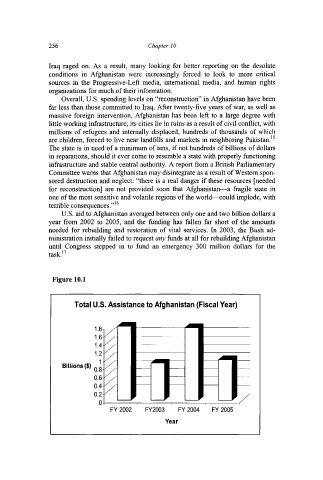
                  U.S. aid to Afghanistan averaged between only one and two billion dollars a
               year from 2002 to  2005, and  the funding has fallen far short of the  amounts
               needed  for rebuilding and restoration of vital services. In 2003, the Bush ad-
               ministration initially failed to request any funds at all for rebuilding Afghanistan
               until  Congress stepped in to  fund  an emergency  300  million dollars for the


                Figure 10.1


                      Total U.S. Assistance to Afghanistan (Fiscal Year)


                  Billions


                                               Year

