


Page 251 - Master Handbook of Acoustics
P. 251
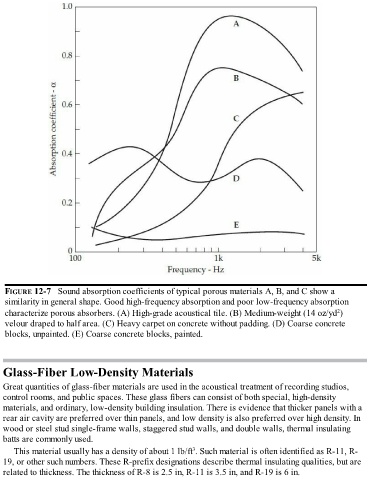
FIGURE 12-7   Sound absorption coefficients of typical porous materials A, B, and C show a

   similarity in general shape. Good high-frequency absorption and poor low-frequency absorption
                                                                                                                 2
   characterize porous absorbers. (A) High-grade acoustical tile. (B) Medium-weight (14 oz/yd )
   velour draped to half area. (C) Heavy carpet on concrete without padding. (D) Coarse concrete
   blocks, unpainted. (E) Coarse concrete blocks, painted.


  Glass-Fiber Low-Density Materials

  Great quantities of glass-fiber materials are used in the acoustical treatment of recording studios,
  control rooms, and public spaces. These glass fibers can consist of both special, high-density
  materials, and ordinary, low-density building insulation. There is evidence that thicker panels with a

  rear air cavity are preferred over thin panels, and low density is also preferred over high density. In
  wood or steel stud single-frame walls, staggered stud walls, and double walls, thermal insulating
  batts are commonly used.
                                                                 3
      This material usually has a density of about 1 lb/ft . Such material is often identified as R-11, R-
  19, or other such numbers. These R-prefix designations describe thermal insulating qualities, but are

  related to thickness. The thickness of R-8 is 2.5 in, R-11 is 3.5 in, and R-19 is 6 in.

