


Page 150 - Mechanical Engineer's Data Handbook
P. 150
THERMODYNAMICS  AND HEAT TRANSFER                                                 139

         rate and the number and dimensions of the tubes are
         given.
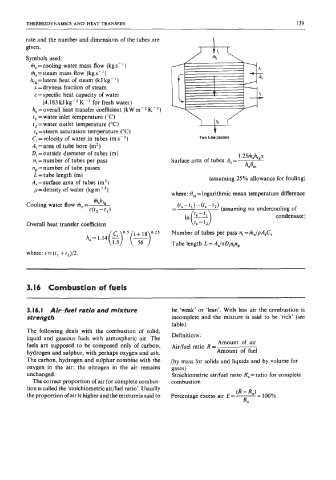
         Symbols used:
          m,=cooling  water mass flow (kgs-’)
          m,=steam  mass flow (kgs-’)
          h,,=latent  heat of  steam (kJkg-’)
           x =dryness  fraction of  steam
           c = specific heat capacity of water
              (4.183 kJkg-’K-’  for fresh water)
           h,=overall  heat transfer coefficient  (kW m-’K-’)
           t, =water inlet temperature (“C)
           t, =water outlet temperature  (“C)               \ui’
           t, = steam saturation temperature (“C)            Two  tube  passes
           C, = velocity of  water in tubes (m s-  I)
           A,=area  of  tube bore (m2)
           D, =outside  diameter of  tubes (m)                           1 .25mshfp
           n,=number  of  tubes per pass             Surface area of  tubes A,=
           np = number of tube passes                                      h06,
           L = tube length (m)
           A, = surface area of  tubes (m’)                     (assuming 25%  allowance for fouling)
           p=density  of water (kgm-’)
                                                     where: ern =logarithmic  mean temperature difference
         Cooling water flow mc=-   k*hf,
                                                     -
                            c(t, - t,)               - (4 - t, 1 - (t, - tz)  (assuming no undercooling of
                                                         In                         condensate)
         Overall heat transfer coefficient
                           h0=1.14(~~’5(7)  ’.*’     Number of  tubes per pass n,=m,/pA,C,
                                         t+ 18
                                                     Tube length L = A$zD,n,np
         where: t = (t, + t2)/2.


         3.16  Combustion of fuels


         3.16. I  Air-fuel  ratio and mixture        be  ‘weak’ or  ‘lean’. With less  air the combustion  is
         strength                                    incomplete and the mixture is  said to be  ‘rich’ (see
                                                     table).
         The following deals  with  the  combustion  of  solid,
         liquid  and  gaseous fuels with  atmospheric  air.  The   Definitions:
         fuels are supposed to be  composed only of  carbon,   Air/fuel  ratio R=  Amount  of  air
         hydrogen and sulphur, with perhaps oxygen and ash.        Amount  of  fuel
         The carbon, hydrogen and sulphur combine with the   (by mass for solids and liquids and by  volume for
         oxygen in  the  air; the  nitrogen  in  the  air  remains   gases)
         unchanged.                                  Stoichiometric air/fuel ratio R, = ratio for complete
           The correct proportion of air for complete combus-   combustion
         tion is called the ‘stoichiometric air/fuel ratio’. Usually
         the proportion of air is higher and the mixture is said to   Percentage excess air   x 100%
                                                                           Rs

