


Page 119 - Methods For Monitoring And Diagnosing The Efficiency Of Catalytic Converters A Patent - oriented Survey
P. 119
Toyota Motor Co. Ltd.                      101


                                    b)  detecting an amount of intake air flow of the engine, and determining
                                      that  the  engine  operating  conditions  are  not  appropriate for  said
                                      determination of the deterioration of the  three-way catalyst when
                                      said amount of intake air flow of the engine becomes smaller than a
                                      predetermined value.


                                         I  c
                     stoic h io mefri-                I  nnlcal
                     airfluel ratio                   1
                                                      I


                                         I                : upstream sensor
                                                           :
                                                .I----. downstream sensor


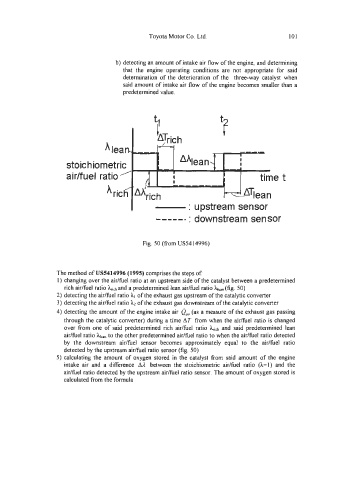
                                            Fig. 50 (from US541 4996)


                  The method of US5414996 (1995) comprises the steps of
                   1)  changing over the aidfuel ratio at an upstream  side of the catalyst between a predetermined
                     rich aidfuel ratio Lch and a predetermined lean aidfuel ratio hr.,  (fig. 50)
                  2) detecting the aidfuel ratio AI of the exhaust gas upstream of the catalytic converter
                  3) detecting the aidfuel ratio  of the exhaust gas downstream of the catalytic converter
                  4) detecting the amount of the engine intake air  Ooir (as a measure of the exhaust gas passing
                     through the catalytic converter) during a time AT  from when the air/fuel ratio is changed
                     over from  one of said  predetermined  rich  aidfuel  ratio  Lilich and  said  predetermined lean
                     aidfuel ratio kcan to the other predetermined aidfuel ratio to when the aidfuel ratio detected
                     by  the  downstream  aidfuel  sensor  becomes  approximately equal  to  the  air/fuel  ratio
                     detected by the upstream aidfuel ratio sensor (fig. 50)
                  5)  calculating the  amount  of  oxygen  stored in  the catalyst from  said  amount of  the  engine
                     intake air  and  a  difference  AA  between  the  stoichiometric air/fuel ratio  @=I)  and  the
                     air/fuel ratio detected by the upstream air/fuel ratio sensor. The amount of oxygen stored is
                     calculated from the formula

