


Page 207 - Microtectonics
P. 207
7.4  ·  Classification of Porphyroblast-Matrix Relations  197
                 7.4.2                                           Chlorite-mica stacks (Fig. 4.14), which are common
                 Pretectonic Porphyroblast Growth              in slates, may be one of the few examples of pretectonic
                                                               (or early syntectonic) porphyroblasts. They occur as lens
                 Pretectonic porphyroblasts are rarely described (Zwart  or barrel-shaped aggregates of chlorite and white mica
                 1962; Fleming and Offler 1968; Vernon et al. 1993a,b) and  in microlithons of slates, with (001) planes at a high
                 seem to be uncommon in areas affected by regional meta-  angle to the foliation and commonly parallel to bed-
                 morphism, except possibly in low-pressure/high-tem-  ding (Beutner 1978; Weber 1981; Craig et al. 1982; van
                 perature metamorphism. Even in the case of contact  der Pluijm and Kaars-Sijpesteijn 1984; Woodland 1985;
                 metamorphism, some deformation may predate porphy-  Gregg 1986; Li et al. 1994). Some chlorite-mica stacks may
                 roblast growth. If present, inclusions in pretectonic por-  have formed as detrital grains (Beutner 1978), but evi-
                 phyroblasts are randomly oriented (a, b in Fig. 7.9;  dence exists for their original growth as crystals parallel
                 Fig. 7.11, ×Video 7.9a, ×Photo 7.11a,b) or show sector  to bedding in a diagenetic foliation at very low to low-
                 zoning (Sect. 7.7; Rice and Mitchell 1991). A primary  grade metamorphic conditions, prior to deformation
                 compositional layering may survive as a ghost layering  (Craig et al. 1982; Woodland 1985; Gregg 1986). Partial
                 (Fleming and Offler 1968). It is incorrect, however, to in-  dissolution and new growth parallel to a developing mi-
                 terpret any crystal with random inclusions as pretectonic;  crolithon of secondary foliation causes their final shape
                 in high-grade rocks, early foliations may be destroyed  (Talbot 1965; Weber 1981; Gregg 1986; Clark and Fisher
                 by grain growth, and subsequent porphyroblast growth  1995; Li et al. 1994).
                 may give rise to apparently pretectonic structures. Also,
                 porphyroblasts with planar inclusion patterns may seem  7.4.3
                 to contain randomly oriented inclusions in sections par-  Intertectonic Porphyroblast Growth
                 allel to S  (Fig. 10.2b). Pretectonic porphyroblasts may
                        i
                 be surrounded by a matrix with polyphase deformation,  The term intertectonic is introduced here for porphyro-
                 as shown in case b in Fig. 7.9 (Vernon et al. 1993a).  blasts that have grown over a secondary foliation, and


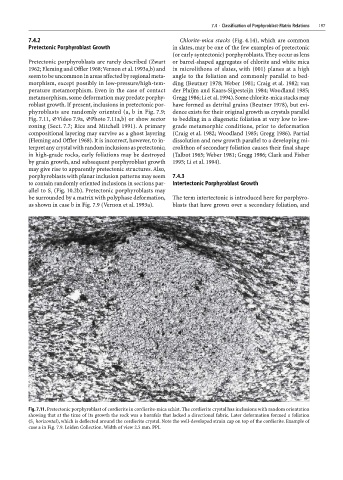
                 Fig. 7.11. Pretectonic porphyroblast of cordierite in cordierite-mica schist. The cordierite crystal has inclusions with random orientation
                 showing that at the time of its growth the rock was a hornfels that lacked a directional fabric. Later deformation formed a foliation
                 (S  horizontal), which is deflected around the cordierite crystal. Note the well-developed strain cap on top of the cordierite. Example of
                  1
                 case a in Fig. 7.9. Leiden Collection. Width of view 2.5 mm. PPL

