


Page 209 - Microtectonics
P. 209
7.4  ·  Classification of Porphyroblast-Matrix Relations  199


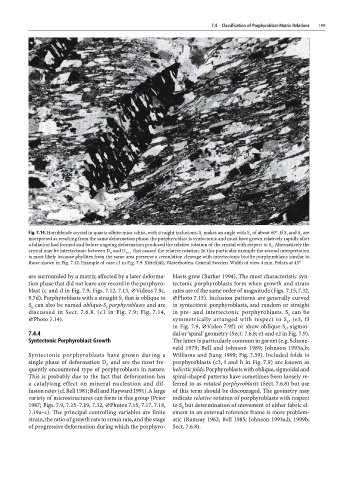
                 Fig. 7.14. Hornblende crystal in quartz-albite-mica schist, with straight inclusions. S  makes an angle with S  of about 60°. If S  and S  are
                                                                                                        e
                                                                                       e
                                                                                                   i
                                                                        i
                 interpreted as resulting from the same deformation phase, the porphyroblast is syntectonic and must have grown relatively rapidly after
                 a foliation had formed and before ongoing deformation produced the relative rotation of the crystal with respect to S . Alternatively the
                                                                                              e
                 crystal may be intertectonic between D  and D n+1  that caused the relative rotation. In this particular example the second interpretation
                                           n
                 is most likely because phyllites from the same area preserve a crenulation cleavage with intertectonic biotite porphyroblasts similar to
                 those shown in Fig. 7.12. Example of case c1 in Fig. 7.9. Kittelfjäll, Västerbotten. Central Sweden. Width of view 4 mm. Polars at 45°
                 are surrounded by a matrix affected by a later deforma-  blasts grew (Barker 1994). The most characteristic syn-
                 tion phase that did not leave any record in the porphyro-  tectonic porphyroblasts form when growth and strain
                 blast (c and d in Fig. 7.9; Figs. 7.12, 7.13, ×Videos 7.9c,  rates are of the same order of magnitude (Figs. 7.15, 7.32,
                 9.7d). Porphyroblasts with a straight S  that is oblique to  ×Photo 7.15). Inclusion patterns are generally curved
                                               i
                 S  can also be named oblique-S  porphyroblasts and are  in syntectonic porphyroblasts, and random or straight
                  e
                                          i
                 discussed in Sect. 7.6.8. (c1 in Fig. 7.9;  Fig. 7.14,  in pre- and intertectonic porphyroblasts. S  can be
                                                                                                    i
                 ×Photo 7.14).                                 symmetrically arranged with respect to S , (e3, f3
                                                                                                   e
                                                               in Fig. 7.9, ×Video 7.9f) or show oblique-S , sigmoi-
                                                                                                   i
                 7.4.4                                         dal or ‘spiral’ geometry (Sect. 7.6.8; e1 and e2 in Fig. 7.9).
                 Syntectonic Porphyroblast Growth              The latter is particularly common in garnet (e.g. Schone-
                                                               veld 1979; Bell and Johnson 1989; Johnson 1993a,b;
                 Syntectonic porphyroblasts have grown during a  Williams and Jiang 1999; Fig. 7.39). Included folds in
                 single phase of deformation D  and are the most fre-  porphyroblasts (c3, f and h in Fig. 7.9) are known as
                                          n
                 quently encountered type of porphyroblasts in nature.  helicitic folds. Porphyroblasts with oblique, sigmoidal and
                 This is probably due to the fact that deformation has  spiral-shaped patterns have sometimes been loosely re-
                 a catalysing effect on mineral nucleation and dif-  ferred to as rotated porphyroblasts (Sect. 7.6.8) but use
                 fusion rates (cf. Bell 1981; Bell and Hayward 1991). A large  of this term should be discouraged. The geometry may
                 variety of microstructures can form in this group (Prior  indicate relative rotation of porphyroblasts with respect
                 1987; Figs. 7.9, 7.15–7.19, 7.32, ×Photos 7.15, 7.17, 7.18,  to S  but determination of movement of either fabric el-
                                                                  e
                 7.19a–c). The principal controlling variables are finite  ement in an external reference frame is more problem-
                 strain, the ratio of growth rate to strain rate, and the stage  atic (Ramsay 1962; Bell 1985; Johnson 1993a,b, 1999b;
                 of progressive deformation during which the porphyro-  Sect. 7.6.8).

