


Page 249 - MODELING OF ASPHALT CONCRETE
P. 249
Unified Disturbed State Constitutive Modeling of Asphalt Concr ete      227


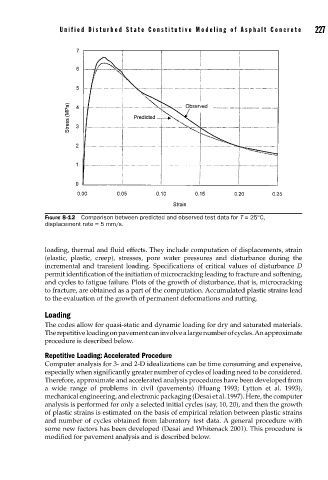
                    FIGURE 8-12  Comparison between predicted and observed test data for T = 25°C,
                    displacement rate = 5 mm/s.


                    loading, thermal and fluid effects. They include computation of displacements, strain
                    (elastic, plastic, creep), stresses, pore water pressures and disturbance during the
                    incremental and transient loading. Specifications of critical values of disturbance  D
                    permit identification of the initiation of microcracking leading to fracture and softening,
                    and cycles to fatigue failure. Plots of the growth of disturbance, that is, microcracking
                    to fracture, are obtained as a part of the computation. Accumulated plastic strains lead
                    to the evaluation of the growth of permanent deformations and rutting.

                    Loading
                    The codes allow for quasi-static and dynamic loading for dry and saturated materials.
                    The repetitive loading on pavement can involve a large number of cycles. An approximate
                    procedure is described below.

                    Repetitive Loading: Accelerated Procedure
                    Computer analysis for 3- and 2-D idealizations can be time consuming and expensive,
                    especially when significantly greater number of cycles of loading need to be considered.
                    Therefore, approximate and accelerated analysis procedures have been developed from
                    a wide range of problems in civil (pavements) (Huang 1993; Lytton et al. 1993),
                    mechanical engineering, and electronic packaging (Desai et al. 1997). Here, the computer
                    analysis is performed for only a selected initial cycles (say, 10, 20), and then the growth
                    of plastic strains is estimated on the basis of empirical relation between plastic strains
                    and number of cycles obtained from laboratory test data. A general procedure with
                    some new factors has been developed (Desai and Whitenack 2001). This procedure is
                    modified for pavement analysis and is described below.

